


FG Assures Nigerians in South Africa of Safety as 269 More Return Amid Renewed Xenophobic Tensions
The Federal Government has reassured Nigerians residing in South Africa of their safety amid renewed xenophobic tensions and anti immigrant protests, while intensifying efforts to evacuate citizens willing to return home.
The assurance came as another batch of 269 Nigerians evacuated from South Africa arrived at the Murtala Muhammed International Airport, Lagos, aboard an Air Peace flight from Johannesburg on Tuesday. The latest returnees bring to 335 the number of Nigerians evacuated in two government coordinated exercises within the past week, following the arrival of 66 returnees on June 24.
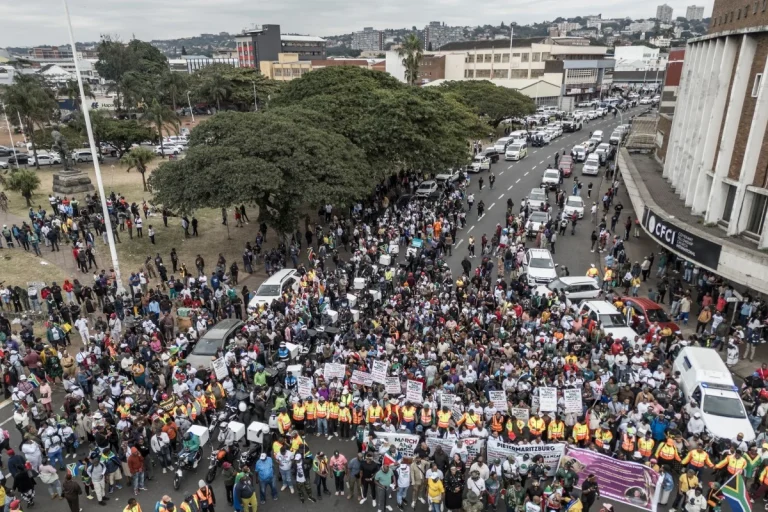
The fresh evacuation followed heightened concerns over anti migrant protests across parts of South Africa, where thousands of demonstrators marched on Tuesday demanding the removal of undocumented foreigners.
Reports also indicated that many Nigerians gathered at the Nigerian High Commission in Pretoria seeking evacuation, while several others took refuge in churches and temporary shelters for fear of possible violence.
The situation was further worsened by the reported killing of a Nigerian businessman popularly known as “Big Joe,” who was allegedly shot dead by unidentified gunmen outside his shop in Witbank, Mpumalanga Province, on Sunday. South African authorities are yet to establish the circumstances surrounding the incident.
Although South African police described the nationwide protests as largely peaceful, isolated cases of looting, vandalism, intimidation and assaults were recorded in some communities. Security personnel, supported by private security outfits and the military, were deployed to prevent violence, particularly in migrant populated areas.
In a statement issued in Abuja, the Ministry of Foreign Affairs said the evacuation exercise remained ongoing despite the June 30 deadline issued by some South African groups asking undocumented foreigners to leave the country.
The ministry, through its spokesperson, Kimiebi Ebienfa, said additional evacuation flights would be arranged to bring back all Nigerians who had completed the screening process and voluntarily opted to return home.
Receiving the latest batch of evacuees, the Director of the African Affairs Department, Ambassador Haruna Ali Gombe, conveyed President Bola Tinubu’s message of reassurance, reaffirming the Federal Government’s commitment to protecting Nigerians living abroad.
The ministry also assured that Nigeria would continue engaging South African authorities at the highest diplomatic level to safeguard the lives and interests of its citizens.
Nigeria’s Acting High Commissioner to South Africa, Temitope Ajayi, said many of the Nigerians who crowded the embassy premises did so after responding to unofficial announcements circulated within the Nigerian community rather than directives from the mission.
According to him, the evacuation exercise is being conducted in phases, with only screened individuals invited when flights become available.
Ajayi disclosed that about 700 Nigerians who voluntarily indicated interest in returning home were still awaiting evacuation, while nearly 150 people were currently being catered for at the Nigerian mission.
He also confirmed that the Nigerian mission had begun engaging South African police over the reported killing of the Nigerian businessman and was still pursuing investigations into previous cases involving Nigerians who died under controversial circumstances earlier this year.
The President General of the Nigerian Union South Africa, Barrister Smart Nwobi, said the union had advised Nigerians to remain indoors while monitoring developments across the country.
He noted that South African President Cyril Ramaphosa had assured foreign nationals of adequate security, adding that the Nigerian Union, the Nigerian High Commission and other organisations were providing food, shelter and other humanitarian assistance to displaced Nigerians.
Nwobi commended the Federal Government for initiating the evacuation exercise and urged state governments to emulate Imo State Governor Hope Uzodimma by supporting returnees with resettlement assistance.
He also called for a review of Nigeria’s bilateral relationship with South Africa in view of recurring xenophobic attacks.
Similarly, the Deputy Chairman of the Nigerian Citizens Association South Africa, Western Cape Province, Leo Azebeokhai, urged the Federal Government to strengthen diplomatic engagement with South African authorities and address challenges affecting Nigerians in the country.
He identified delays in passport renewal, residence permits and work documentation as major factors contributing to the difficulties faced by many Nigerians, stressing that many had become undocumented due to administrative bottlenecks rather than deliberate violations of immigration laws.
Azebeokhai also appealed for faster evacuation of stranded Nigerians, noting that many had abandoned their homes and livelihoods after the government announced plans to repatriate them.
Meanwhile, retired Nigerian diplomats have advised the Federal Government to deepen diplomatic engagement with South Africa, accelerate the evacuation of willing returnees and pursue long term measures through the African Union to address recurring xenophobic attacks.
The National Association of University Students also condemned the renewed anti migrant protests and warned that it would embark on peaceful nationwide demonstrations if South African authorities failed to take concrete steps to guarantee the safety of Nigerians within one week.
Despite the tensions, the Association of Yorubas in Diaspora, South Africa, said Tuesday’s anti immigrant protests ended peacefully without any reported attacks on Nigerians or other foreign nationals, adding that the demonstrations were directed against illegal immigration and did not degenerate into widespread violence.