


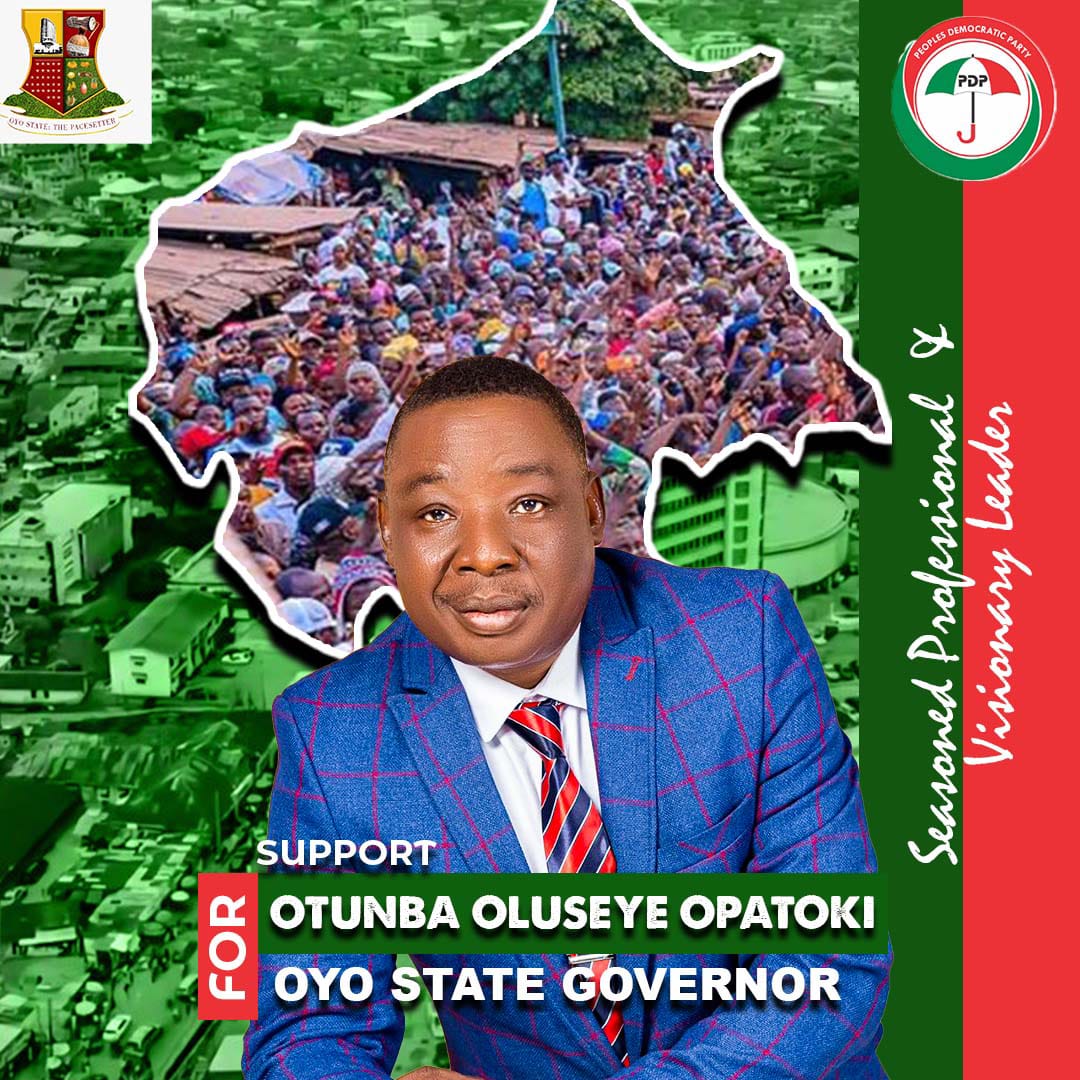
Oyo 2027: The Oke Ogun Blueprint for Security, Food Production & Political Balance — Otunba Oluseye Opatoki’s Vision
“ No state is stronger than its most neglected region. Develop the flank and you secure the centre.”
Every governorship election in Oyo is decided in Ibadan but shaped in Oke Ogun. The region’s ten local governments carry swing votes, the food basket, and the border pressures that quietly determine outcomes. Ahead of Governor Seyi Makinde’s May 2026 succession decision, Otunba Oluseye Oladosu Opatoki is positioning Oke Ogun as the testing ground of a new state strategy.
His central argument is simple. Oke Ogun should not be treated as a voting bloc but as an economic corridor. In his proposed structure, security and agriculture are merged because in places like Saki, Iseyin and Igbeti, both realities are inseparable. Farming collapses where fear exists.
The Corridor Plan begins with roads but redefines their purpose. Instead of focusing only on links between towns, it prioritises short feeder routes that connect farms directly to markets. A spur from Tede to a cassava cluster can save hours per trip. When multiplied across hundreds of weekly movements, the savings translate into hundreds of millions of naira retained within the rural economy.
Security is reframed as investment protection. The plan proposes Agro Ranger Units built from Amotekun personnel, trained in drone surveillance, and supported with structured military cooperation. Funding comes from a small surcharge on commodity sales. The principle is direct. Farmers must also protect the value chains they depend on.
Water infrastructure forms the second pillar. Seventeen dormant dams across Oke Ogun have been identified for revival. Under the proposal, private operators would manage them under concession agreements while paying royalties to host communities. With irrigation, farming becomes a multi cycle activity rather than a seasonal gamble, increasing productivity and reducing rural migration.
What distinguishes this approach is sequencing. Previous interventions often addressed roads without security or security without water. The Corridor Plan integrates all three within ten pilot clusters first, then scales based on results. It is designed as a working model, not a political announcement.
Traditional institutions are central to implementation. Each cluster is anchored by a Land Peace Committee led by a monarch and including farmers, herders and security representatives. Disputes are expected to be resolved within fourteen days or escalated to the state level. The aim is to reduce the recurring farmer herder conflicts that dominate administrative attention.
Politically, the strategy is double edged. It gives Oke Ogun leaders ownership of a system rather than temporary attention. It also provides a continuity narrative for the outgoing administration. If successful, the story becomes one of completion rather than replacement.
Otunba Oluseye Oladosu Opatoki’s engagement style reflects this shift. He avoids large rallies and instead visits cooperatives directly on farms. The imagery is deliberate. He is seen engaging with produce and production rather than podiums and speeches, a contrast that resonates in communities fatigued by symbolic visits.
The plan also responds to long standing concerns about centralisation. By proposing relocation of key ministries such as Agriculture to Saki and Solid Minerals to Igbeti, it physically redistributes administrative attention. The belief is that governance improves when decision makers live closer to the realities they manage.
On the political front, the Corridor Plan introduces a competitive challenge. The opposition has traditionally relied on federal influence and border infrastructure promises. This model shifts the conversation toward measurable local outcomes such as water access, farm productivity and rural security.
Gender inclusion is embedded structurally. Each cluster cooperative is required to ensure significant female land ownership participation. Widows are prioritised for irrigation access. The logic is economic as much as social, since women often demonstrate higher repayment discipline and stronger community stability.
Timing is also critical. With planting cycles beginning early in the year, policy decisions made around the 2026 transition window could determine whether the model is operational before the peak of the 2027 political season. In this framework, timing is treated as part of governance design.
Critics argue the approach is overly focused on one region. Supporters counter with data. Oke Ogun holds the majority of Oyo State arable land but lags in infrastructure development. Closing that gap, they argue, directly impacts internally generated revenue, employment and security across the entire state.
In 2019, Governor Makinde secured strong support in Oke Ogun on the promise of inclusion. In 2027, the test will be whether inclusion evolves into structural integration. Otunba Oluseye Oladosu Opatoki’s Corridor Plan is ultimately a wager that Oke Ogun is no longer just a deciding region. It is ready to become a defining one.