


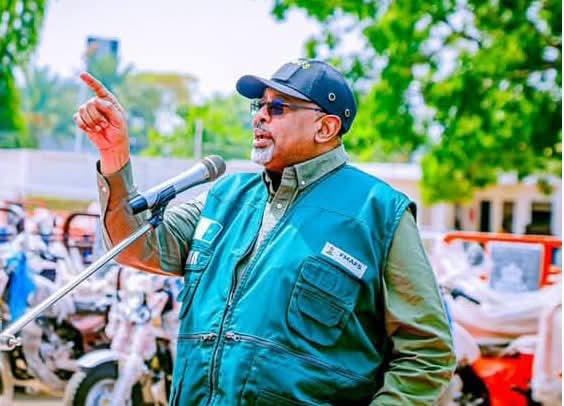
Food Prices Have Reduced By 50% — Agric Minister
The Minister of Agriculture and Food Security, Abubakar Kyari, has said the prices of essential food commodities have reduced by up to 50 per cent across the country.
Kyari disclosed this on Monday in Maiduguri while declaring open the Community of Practice Meeting of Commissioners for Agriculture, Health, Environment and Rural Development in Borno State.
The meeting was organised by the Federal Ministry of Agriculture and Food Security in collaboration with the Borno State Government, with support from Germany, under the theme, “Stronger Partnerships for a Food Secure Nigeria.”
Addressing participants, Kyari said President Bola Tinubu had placed food security at the centre of the Federal Government’s national agenda.
He said the government’s responsibility was to translate that mandate into increased agricultural production, greater affordability, stronger rural economies and a more resilient food system.
“We have seen a reduction of up to 50 per cent in the prices of some essential food commodities, alongside expanded input delivery, investment in rural infrastructure and support for smallholder farmers,” the minister said.
Kyari stressed that the prices of some food items had dropped significantly compared with their levels before 2023.
“Let’s be honest, how much was a bag of rice and maize in 2023, and how much is it now? What is the percentage? Let us not play politics with these things,” he added.
The minister, however, noted that the meeting would also take into account the Kampala Comprehensive African Agricultural Development Programme Declaration and its Strategy and Action Plan for 2026–2035.
He said the Kampala framework adopted a broader agrifood systems approach, with priorities covering sustainable production, investment and finance, food and nutrition security, trade, inclusion, resilience and stronger governance.
“For a country of Nigeria’s scale, the choices we make in agriculture have consequences beyond our borders, for regional markets, Africa’s wider agrifood transformation and Nigeria’s place in the global food economy,” Kyari said.
He added that Nigeria had developed and validated a 10-year National Agrifood System Strategy and Action Plan as the vehicle for domesticating the commitments under the framework.
Kyari said the meeting provided an important sub-national platform for translating the declaration into concrete action, urging states to align their agricultural plans with national priorities.
He specifically called for greater attention to rural infrastructure, extension services, access to credit and quality inputs, labour-saving technologies, reduction of post-harvest losses and climate-resilient agriculture.
Speaking earlier, the Head of Development Cooperation at the German Embassy in Nigeria, Dr Karin Jansen, assured participants that Germany would continue to support Nigeria by strengthening agricultural policy processes, scaling successful approaches and promoting civil society participation.
Jansen said the goal was to strengthen existing structures and translate national commitments into practical results, adding that the success of the Kampala Agenda would ultimately be measured by better policies, stronger institutions, effective investments and tangible improvements in people’s lives.