


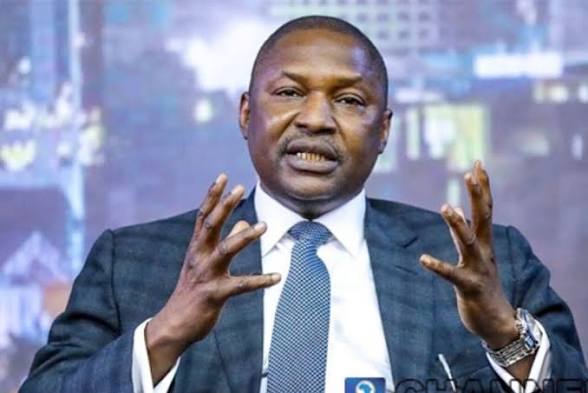
Mambilla: ICC Tribunal Finds Ex-AGF Malami Acted Against Nigeria’s Interest
An International Chamber of Commerce (ICC) arbitration tribunal has criticised former Attorney-General of the Federation (AGF), Abubakar Malami, over his handling of the Mambilla hydropower dispute, finding that his conduct was contrary to Nigeria’s interests.
The tribunal, according to a 616-page final award delivered in Paris on September 16, 2026, examined Malami’s role in the settlement of the dispute between the Federal Government and Sunrise Power and Transmission Company Limited, promoted by Leno Adesanya.
The three-member tribunal, chaired by Melanie van Leeuwen, with Simon Nesbitt KC and Stavros Brekoulakis as co-arbitrators, rejected Sunrise’s claims against Nigeria in their entirety.
It ruled that Malami and Saleh Mamman, who was Minister of Power at the time, lacked the authority to bind the Federal Government to the settlement agreements they signed in January and March 2020 without presidential approval.
The tribunal also found that the settlement agreement and its addendum were products of corruption and therefore unenforceable because they violated Nigerian public policy.
The proceedings arose from agreements signed by Malami and Mamman on behalf of the Federal Government in January and March 2020.
Under the original January 21, 2020 agreement, Nigeria was to pay Sunrise $200 million in a single instalment. A default would have resulted in Sunrise being reinstated as the exclusive local content partner for the Mambilla project, while interest on unpaid sums would accrue at 10 percent annually.
However, an addendum signed on March 25, 2020 split the payment into two $100 million instalments and introduced an additional $200 million default penalty. Interest on outstanding sums was also changed to 10 percent per annum, compounded daily.
The tribunal said the revised terms represented a substantial deterioration of Nigeria’s position, adding that it could not identify any corresponding benefit to the country.
According to the award, the revised arrangement potentially exposed Nigeria to $400 million, instead of the original $200 million, in addition to interest.
The tribunal consequently concluded that Malami had not negotiated the revised terms on behalf of Nigeria, but for Sunrise.
It stated that, as the chief law officer of the federation, Malami had a responsibility to act in Nigeria’s interest, but found that his actions had the opposite effect.
The tribunal also examined Malami’s relationship with Adesanya, noting what it described as an inappropriate level of communication and cooperation between individuals who were supposed to represent opposing interests.
It further considered evidence concerning Malami’s change in position on Adesanya and Sunrise.
In January 2018, Malami had reportedly described Adesanya as “a criminal of the highest order” in an email to then President Muhammadu Buhari’s Chief of Staff and referred to him as the “number 1 enemy” of the Mambilla project.
He had also previously taken the position that Sunrise had no valid basis for its claim arising from a 2003 Federal Executive Council decision concerning the Mambilla project.
However, by January 2020, Malami had approved a $200 million settlement offer to Sunrise and subsequently signed the settlement agreement and its addendum.
The tribunal said it found the reversal in Malami’s position significant and questioned the basis for the change.
The tribunal also examined handwritten instructions issued by Malami shortly after the original settlement agreement was signed, directing that the payment be staggered and calling for other aspects of the agreement to be renegotiated.
It described the circumstances surrounding the renegotiation as suspicious and considered them alongside testimony by Adesanya alleging that Malami had solicited a bribe.
Adesanya reportedly told the tribunal that he possessed audio and video recordings relating to the alleged conversation, but declined to produce them, citing concerns for his safety and that of his family.
The tribunal drew an adverse inference from the non-production of the recordings and said the restructuring of the settlement into two $100 million instalments corresponded with Adesanya’s account of the alleged demand.
It ultimately found, on the balance of probabilities, that a corrupt agreement existed between Malami and Adesanya under which Malami was allegedly promised a share of the money Sunrise would receive.
The tribunal said Malami cooperated in committing Nigeria to the settlement obligations and in coordinating steps connected with the arbitration proceedings.
However, it expressly declined to find that any portion of the additional $200 million default penalty had been promised to Malami or Mamman, saying the available evidence was insufficient to establish that claim.
The tribunal also criticised communications between Malami and Adesanya during the arbitration proceedings, describing their exchanges and cooperation as inappropriate.
It said Adesanya had supplied Malami with proposed letters to be issued in the name of the Federal Government, including one that purported to convey Buhari’s approval for the immediate payment of $200 million to Sunrise.
According to the tribunal, Buhari had not given such approval.
The tribunal further found that Malami and Mamman signed the settlement agreement and its addendum without first obtaining approval from Buhari or the Federal Executive Council.
Malami subsequently sought Buhari’s approval, but the former president declined the request on April 20, 2020, stating that the Federal Government did not have $200 million to pay Sunrise.
The tribunal said Malami later returned to Buhari with further proposals, including a January 11, 2021 request for approval to continue negotiations with Sunrise.
Buhari responded with the words, “Not approved.”
The tribunal said the response left no room for interpretation and described Malami’s persistence in seeking approval despite the president’s position as remarkable.
It ultimately found that no presidential approval had been obtained for the agreements, either expressly or implicitly, before or after their execution.
The tribunal also ruled that Malami and Mamman lacked both actual and apparent authority to bind Nigeria.
On the financial implications of the settlement, the tribunal found that Malami supplied Buhari with incorrect information in an August 17, 2020 brief.
Malami had reportedly told Buhari that the settlement would cost Nigeria $200 million and save the government $2.154 billion in potential liability.
The tribunal said the information was inaccurate because the addendum had introduced the additional $200 million default sanction and daily-compounded interest.
It also faulted Malami for failing to inform Buhari that Sunrise had not established the damages it was claiming.
The tribunal further questioned aspects of Malami’s written evidence after he denied involvement in draft settlement terms exchanged in January 2020.
It found other evidence inconsistent with his account and said it was not convinced by his denial in relation to certain aspects of the negotiations.
Malami also declined to appear for oral examination at the January 2025 hearing in Paris, despite having submitted a witness statement on Nigeria’s behalf.
Nigeria informed the tribunal that Malami no longer wished to testify because he was under investigation by the Economic and Financial Crimes Commission (EFCC).
The tribunal noted that Malami was in Paris during the hearing and had accompanied Buhari, who appeared and gave evidence.
It consequently accorded limited weight, if any, to Malami’s witness statement and expressed dissatisfaction with his refusal to submit to cross-examination.
After reviewing the settlement negotiations, Malami’s change in position, his attempts to secure presidential approval and his communications with Adesanya, the tribunal identified several issues it regarded as significant red flags.
It concluded that the January 2020 settlement agreement and the March 2020 addendum were products of corruption and therefore unenforceable under Nigerian public policy.
The tribunal also dismissed Sunrise and Adesanya’s claims and ordered them to reimburse Nigeria $11.82 million in legal fees and $414,125 in arbitration costs. They were also directed to bear their own legal expenses.