


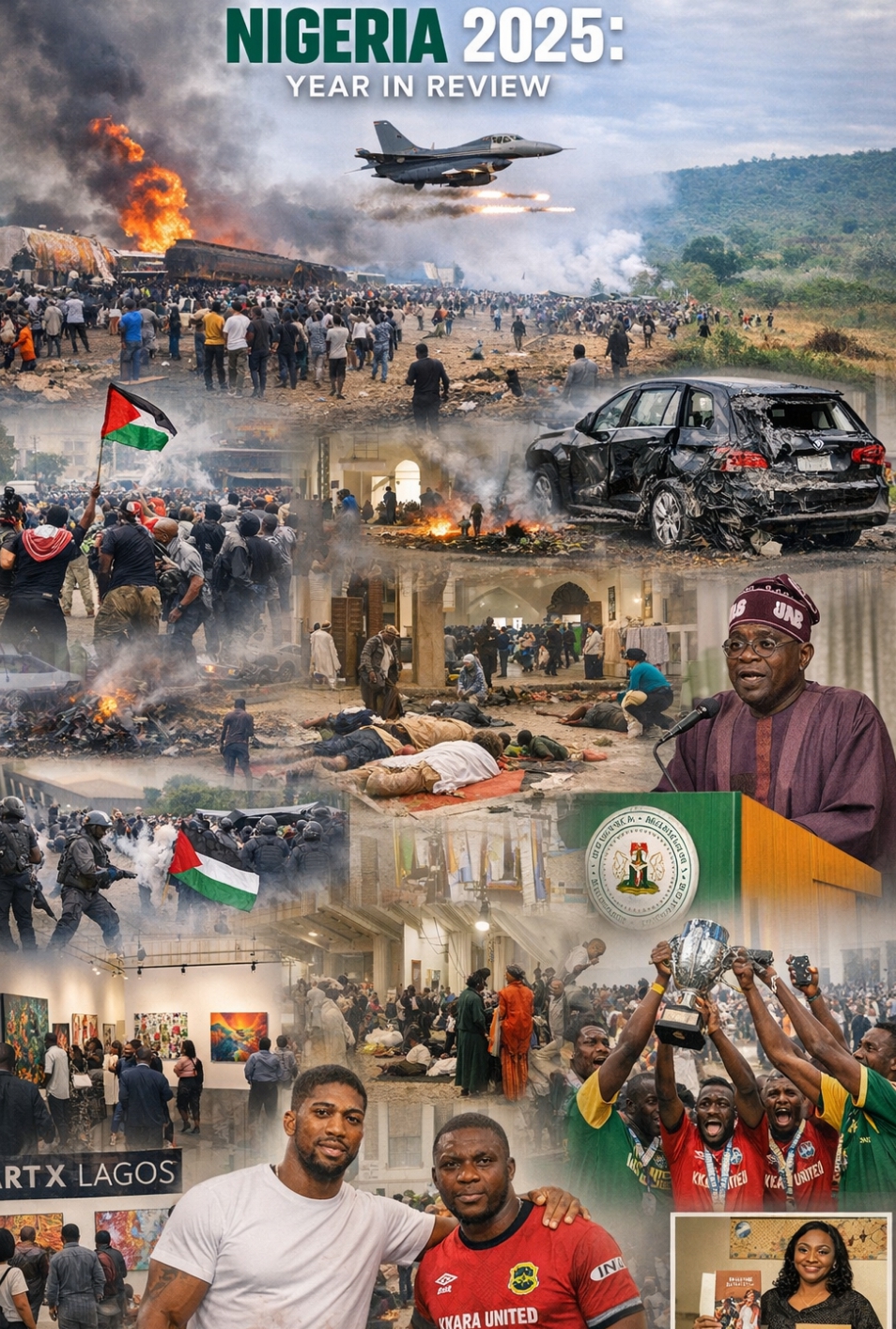
Recap of the Major Events That Shaped Nigeria in 2025; The Good, The Bad And The Ugly
By Micheal Oladejo
The year 2025 was a defining period for Nigeria, marked by economic hardship,
deadly disasters, persistent insecurity, political flashpoints and moments of resilience that together shaped national discourse and public life.
Nigeria’s year began with tragedy on 18 January, when a fuel tanker explosion near Suleja in Niger State killed more than 100 people. The incident shocked the nation and highlighted the dangers of fuel transportation, poverty-driven risk-taking and weaknesses in emergency response systems.
Through January and February, insurgent violence continued in the northeast as Boko Haram and Islamic State West Africa Province fighters attacked communities and military targets in Borno State, forcing civilians to flee and worsening an already dire humanitarian situation.
Banditry and mass kidnappings remained a major threat across the northwest and north-central regions in February, with attacks on highways, villages and farmlands disrupting daily life and economic activity.
On 18 March, President Bola Tinubu declared a state of emergency in Rivers State, citing political instability and security concerns in the oil-rich region. The decision dominated political debate and raised questions about federal intervention and democratic norms.
Tensions flared again on 28 March in Abuja, where clashes between security forces and members of the Islamic Movement of Nigeria during a pro-Palestinian march left several people dead, drawing international attention to protest policing in Nigeria.
Natural disasters deepened the country’s challenges in late May, when devastating floods struck Mokwa and surrounding communities in Niger State on 28–29 May, killing hundreds, displacing thousands and destroying homes and farmland.
Violence spread to new areas on 4 June, when gunmen attacked a mining site in Oreke-Okeigbo, Kwara State, killing police officers and abducting workers, highlighting the widening reach of insecurity.
Throughout June and July, labour unrest escalated as doctors and university lecturers embarked on strikes over wages and working conditions, disrupting healthcare services and higher education nationwide.
Humanitarian agencies repeatedly warned in mid-2025 that food insecurity was worsening across northern Nigeria, driven by conflict, flooding and reduced international aid.
A major political and economic moment came on 25 October, when President Tinubu presented the 2026 federal budget to the National Assembly, outlining increased spending on security, infrastructure and social welfare while acknowledging fiscal pressure from debt servicing and inflation.
In November, fierce clashes between rival jihadist factions near Lake Chad reportedly killed around 200 fighters, revealing internal divisions within insurgent groups even as violence against civilians persisted.
By December 2025, inflation, unemployment and insecurity continued to dominate public concern, shaping perceptions of government policy and reform efforts.
Despite the crises, the government pursued economic reforms and investment drives. On 1 December, Nigeria launched a major oil licensing round, offering dozens of oil blocks in an effort to boost production and revenue.
The year ended with renewed shock on 25 December, when a suspected suicide bombing at a mosque in Maiduguri, Borno State, killed worshippers during prayers, underscoring the enduring insurgent threat.
On the same day, 25 December, Nigeria drew global attention as the United States carried out airstrikes against ISIS-linked targets in Sokoto State, marking a rare instance of direct foreign military action on Nigerian soil.
Nigeria also made global sports headlines in late December, when British-Nigerian heavyweight boxing star Anthony Joshua was injured in a serious car accident in Nigeria, an incident that killed others and drew international concern and media attention.
As the year closed, Nigeria stood at a critical crossroads scarred by loss and instability, yet sustained by resilience, civic engagement and ongoing efforts to confront long-standing challenges.