


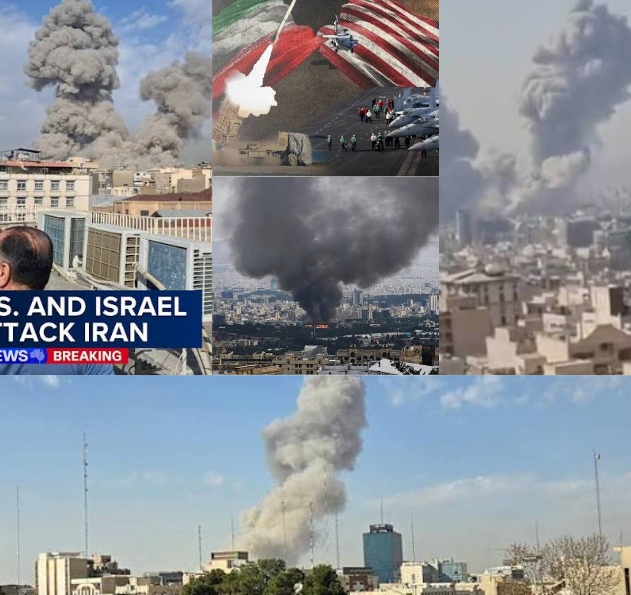
War Begins: Airspaces Closed As US/Israel Launch Major Strikes on Tehran, Iran Opens Up Nuclear Sites; Fire Missiles at America
The United States and Israel have launched coordinated military strikes on Iran, sharply escalating tensions across the Middle East and prompting fears of a wider regional war.
United States President Donald Trump announced that the US had begun “major combat operations” in Iran, shortly after Israel confirmed it had carried out missile attacks on Iranian targets. The developments mark one of the most significant confrontations between the longtime adversaries in recent years.
Iran’s Revolutionary Guard Corps (IRGC) said it responded with a large-scale wave of missile and drone attacks toward Israel. A senior Iranian official told Al Jazeera that “all American and Israeli assets and interests in the Middle East have become legitimate targets,” warning that Tehran’s response would have “no red lines” and could include scenarios not previously considered.
Explosions were reported across Iran, including in the capital, Tehran, as well as in the western city of Ilam. Iranian state media said President Masoud Pezeshkian was “safe and sound,” though there was no immediate comprehensive official statement outlining Tehran’s strategy.
The fallout quickly spread beyond Iran’s borders. Bahrain confirmed that the headquarters of the US Navy’s Fifth Fleet in Juffair had been targeted by a missile attack. An explosion was also reported in Abu Dhabi, capital of the United Arab Emirates, while sirens sounded in Kuwait amid reports of blasts. Qatar’s Defence Ministry said an Iranian missile had been intercepted by its Patriot air defence system.
In response to the escalating security threat, Qatar, Kuwait and the UAE closed their airspace, advising residents to remain indoors and away from military installations. Iraq and Israel also shut their airspace, cancelling civilian flights. Several international carriers, including Lufthansa, KLM and Wizz Air, suspended routes to and from key destinations across the region.
In Moscow, Dmitry Medvedev, deputy chairman of Russia’s Security Council, accused Washington of using nuclear negotiations with Iran as a cover for military action. Writing on Telegram, Medvedev said the United States had shown its “true colours,” alleging that talks were never intended to produce a genuine agreement.
In Israel, political analyst Akiva Elder said Prime Minister Benjamin Netanyahu was attempting to frame the offensive as a historic turning point, promising regime change in Tehran. Elder suggested many Israelis remain sceptical, arguing that Netanyahu is “changing the agenda” and presenting the conflict as unavoidable.
The strikes come amid renewed US accusations that Iran is pursuing nuclear weapons, a claim Tehran has consistently denied. Just days earlier, Iranian officials reiterated at the United Nations Conference on Disarmament that the country would “never seek nuclear weapons,” maintaining that its nuclear programme is for peaceful purposes.
As military exchanges intensified, global internet monitor NetBlocks reported that Iran was experiencing a near-total internet blackout, with connectivity dropping to about four percent of normal levels — a measure similar to restrictions imposed during previous periods of conflict.
With missiles launched, airspaces closed and regional powers trading threats, the confrontation has pushed the Middle East into one of its most volatile moments in years, with uncertainty growing over how far the conflict may spread.