


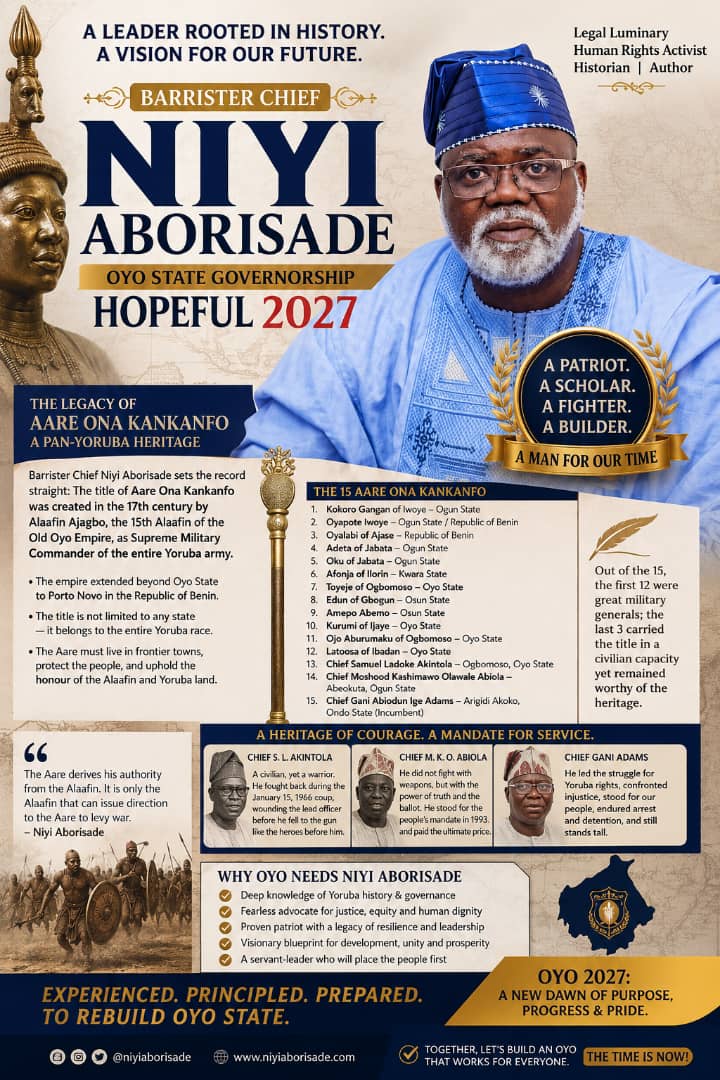
AARE ONA KAKANFO: Aborisade Sets Record Straight on Yoruba Military Title
Renowned legal practitioner, human rights activist, Oyo State 2027 Governorship hopeful,historian, and author, Niyi Aborisade, has offered a detailed historical reflection on the institution of the Aare Ona Kakanfo, insisting that the prestigious title transcends geographical boundaries within present-day Oyo State and belongs to the entire Yoruba nation.
In a historical discourse titled “Reflections Without Mirror,” Aborisade argued that misconceptions surrounding the authority and scope of the Aare Ona Kakanfo have persisted for years, prompting the need to revisit the origins and traditions attached to the revered office.
According to him, the title was established by Alaafin Ajagbo, the 15th Alaafin of the Old Oyo Empire, during the 17th century. The office was created as the highest military command in the empire, making the holder the supreme field marshal and defender of Yoruba territories.
Aborisade noted that the Old Oyo Empire was far larger than present-day Oyo State, extending into areas that now form parts of the Republic of Benin. Consequently, he maintained that the authority and historical significance of the Aare Ona Kakanfo cannot be confined to any single state within modern Nigeria.
He explained that Alaafin Ajagbo introduced strict traditions and taboos to regulate the immense powers attached to the office. One such restriction was a prohibition against the Aare waging war against Iwere-Ile, an ancient town in present-day Oyo State and the maternal homeland of the Alaafin.
Tracing the historical lineage of the title, Aborisade listed the fifteen individuals who have held the office since its creation. From Kokoro Gangan of Iwoye to the incumbent, Gani Adams of Arigidi Akoko, the holders emerged from different Yoruba communities spread across present-day Ogun, Oyo, Osun, Kwara, Ondo States and the Republic of Benin.
“The historical record clearly demonstrates that the institution belongs to the entire Yoruba race and not to any particular state,” he argued.
The historian further explained that tradition required every Aare Ona Kakanfo to reside in frontier towns rather than in the same city as the Alaafin. The arrangement was designed to ensure the protection of the empire’s borders while maintaining a balance of power between the monarch and his chief military commander.
While describing the relationship between both offices, Aborisade emphasized that although the Aare wielded enormous military influence, his authority was derived from and subordinate to that of the Alaafin, who alone possessed the power to authorize military campaigns.
He observed that the first twelve holders of the title were accomplished military commanders who distinguished themselves in warfare, while the last three holders Chief Samuel Ladoke Akintola, Chief Moshood Kashimawo Olawale Abiola, and Chief Gani Adams—received the title largely as civilians.
However, he argued that both Akintola and Adams demonstrated qualities associated with the historical spirit of the office.
Aborisade recalled that Akintola, despite being a civilian politician, resisted the military officers who invaded his residence during the January 15, 1966 coup. According to historical accounts cited by the author, Akintola fought back and reportedly wounded one of the coup leaders before he was eventually killed.
He also highlighted the role played by Gani Adams during the pro-democracy struggles and ethnic self-determination agitations of the late 1990s and early 2000s. As leader of the Oodua People’s Congress (OPC), Adams became a prominent figure in Yoruba activism, confronting perceived threats against Yoruba interests and enduring arrest and detention by federal authorities.
On the late Chief MKO Abiola, Aborisade acknowledged that while the business mogul did not engage in physical warfare, he fought a political battle to reclaim the mandate believed to have been freely given to him by Nigerians in the annulled June 12, 1993 presidential election. His struggle, Aborisade noted, ultimately led to his detention and death in custody.
The legal luminary concluded that a proper understanding of Yoruba history requires recognition of the Aare Ona Kakanfo as a pan-Yoruba institution rooted in the military traditions of the Old Oyo Empire.
For Aborisade, the historical evidence remains unmistakable: the title of Aare Ona Kakanfo was conceived as the highest military office of the Yoruba nation, and its legacy continues to reflect the collective heritage, courage, and aspirations of the Yoruba people across generations.