


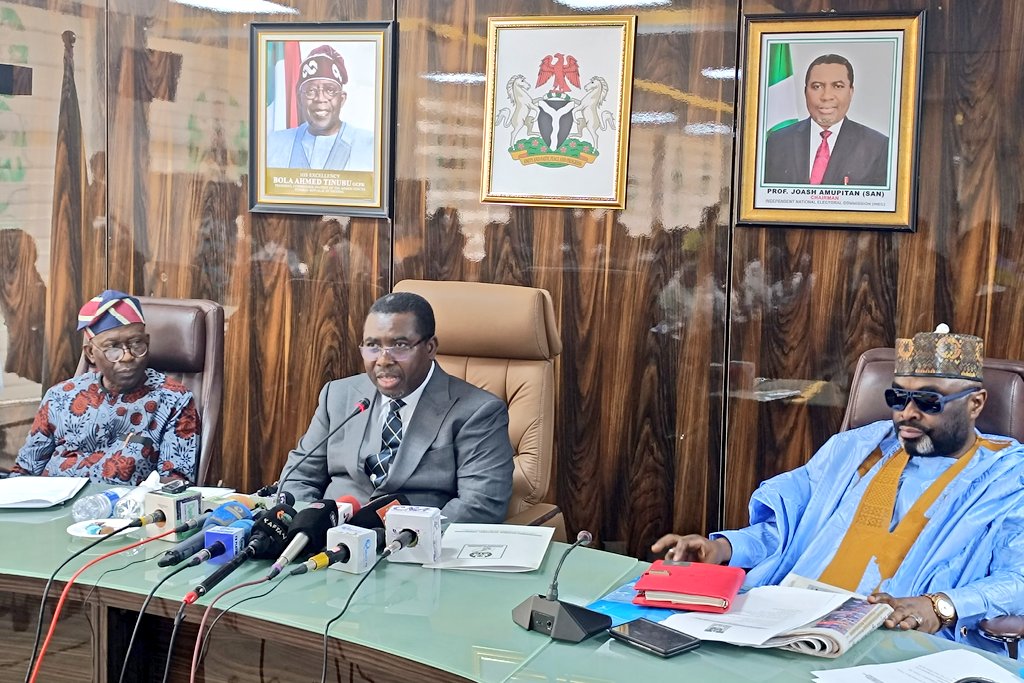
INEC Chairman Reviews FCT Council Elections, Swears in Enugu REC
The Chairman of the Independent National Electoral Commission (INEC), Prof. Joash O. Amupitan, SAN, on Tuesday presided over a high-level meeting with Resident Electoral Commissioners (RECs) from the 36 states and the Federal Capital Territory (FCT), received a delegation from the Forum of State Independent Electoral Commissions of Nigeria (FOSIECON), and administered the oath of office to the re-appointed Resident Electoral Commissioner for Enugu State, Dr. Chukwu Chukwuemeka Joseph.
The engagements, held at the Commission’s headquarters in Abuja, blended ceremony with scrutiny, as the Chairman led a comprehensive review of the recently concluded FCT Area Council and state constituency elections while outlining preparations for forthcoming off-cycle governorship elections and the 2027 General Election.
Earlier in the day, Prof. Amupitan welcomed the FOSIECON delegation led by its National Chairman, Mamman Nda Eri. The delegation congratulated the INEC Chairman on his appointment and commended the Commission’s longstanding role in institutional reform and electoral innovation.
Mr. Eri outlined a five-point proposal for deeper collaboration between INEC and state electoral bodies, including joint capacity-building programmes, technology sharing—particularly the adaptation of the Bimodal Voter Accreditation System (BVAS)—structured policy dialogue, harmonised voter education initiatives, and peer review mechanisms for electoral best practices.
In his response, Prof. Amupitan underscored the importance of synergy across all tiers of electoral administration. He noted that collaboration and open dialogue remain essential to strengthening the integrity and progress of Nigeria’s electoral processes, adding that shared responsibility among electoral institutions is critical to upholding democratic principles nationwide.
At the core of the meeting was a candid appraisal of the 21 February 2026 elections in the FCT and select states. In the FCT Area Council election, approximately 239,000 voters cast their ballots, representing a turnout of about 15 percent. This marked a measurable increase from the 9.4 percent turnout—148,685 voters—recorded in 2022. While describing the improvement as encouraging, the Chairman acknowledged that voter apathy remains a significant challenge in the territory.
The Commission also reported notable gains in transparency and results management. Over 93 percent of polling unit results were uploaded to the INEC Result Viewing (IReV) portal by 2:00 p.m. on Sunday, with the figure later rising to an average of 97 percent.
The Chairman described this performance as evidence of growing institutional efficiency and commitment to openness.
Prof. Amupitan firmly dismissed rumours of “voter migration” in 2026, clarifying that the exercise formed part of the 2022 polling unit expansion programme. Under that initiative, 6.7 million voters were redistributed nationwide, 12,000 congested polling units were decongested, and 17,000 new polling units were created.
In the FCT alone, 580,000 voters were reassigned to 1,156 newly created polling units to improve accessibility and reduce overcrowding. He directed all RECs to intensify voter education campaigns and urged citizens to verify their polling units through the Commission’s online platforms.
Despite the progress recorded, the Chairman expressed strong dissatisfaction over the late opening of polling units. Data from the Commission’s Election Operations Dashboard revealed that only 45 percent of polling units in the FCT commenced accreditation and voting by the stipulated 8:30 a.m.
Although all units were operational by 10:00 a.m., he described the initial delays as unacceptable and warned that there would be consequences for any actions capable of undermining the electoral process.
He disclosed that staff responsible for delays in Kuje Area Council and Kabusa Ward have been formally queried, while the transporter linked to delays in Kwali Area Council will be blacklisted.
The Commission, he stressed, will not tolerate operational lapses that compromise efficiency or public confidence.
The meeting concluded with renewed emphasis on preparedness for upcoming governorship elections in Ekiti and Osun states, as well as early strategic planning toward the 2027 General Election.
Through strengthened institutional collaboration, technological reinforcement, stricter accountability measures, and intensified voter engagement, the Commission signaled its resolve to consolidate recent gains in the FCT, where improved turnout and high result-upload rates reflect gradual but measurable progress in electoral administration.