


FG Upgrades 3,526 Primary Healthcare Centres, Retrains 78,000 Health Workers
The Federal Government has renovated 3,526 primary healthcare centres (PHCs), retrained more than 78,000 skilled birth attendants and expanded health insurance coverage to 23.02 million Nigerians as part of efforts to improve access to affordable and quality healthcare.
The National Primary Health Care Development Agency (NPHCDA) is rehabilitating an additional 908 facilities, bringing the total number of healthcare centres covered by its revitalisation programme to 4,434. Meanwhile, the National Health Insurance Authority (NHIA) has recorded a 42 per cent increase in insurance enrolment over the past 18 months.
The government has also approved an additional ₦40 billion through the Basic Health Care Provision Fund (BHCPF) to strengthen medical supplies, improve drug security and support emergency transportation.
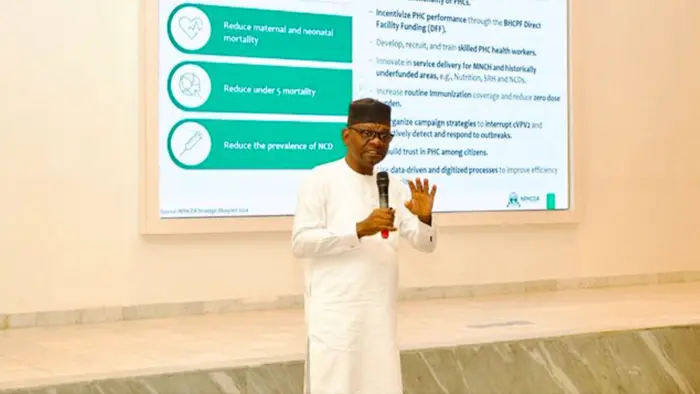
These developments were disclosed during a quarterly media briefing in Abuja on Thursday by the Executive Director of the NPHCDA, Dr Muyi Aina, and the Director-General of the NHIA, Dr Kelechi Ohiri.
Aina said the agency was working to improve access to functional healthcare facilities across wards, particularly in underserved communities. He explained that level-two primary healthcare centres were expected to have reliable electricity, water and sanitation facilities.
According to him, the number of level-two PHCs has increased by 59 per cent from the March 2024 baseline, with more than half of Nigeria’s approximately 27,000 primary healthcare centres operating at level one or level two.
On workforce development, Aina said more than 78,000 skilled birth attendants had been retrained under the presidential initiative to train 120,000 frontline health workers, while training had commenced for another 23,000 community-based health workers.
He added that the Federal Government had equipped more than 500 primary healthcare centres, complementing investments by state governments and development partners.
Aina said the interventions had contributed to an increase in quarterly patient visits from approximately 33 million to between 43 million and 45 million, with the figure peaking at 46 million in 2025.
He also disclosed that first antenatal visits increased from 1.6 million to 1.8 million per quarter, while fourth antenatal visits rose by 38 per cent, from 598,000 in 2023 to about 830,000 in 2025.
Similarly, quarterly births attended by skilled health personnel increased from 483,000 to nearly 700,000, reflecting improved access to maternal healthcare services.
Under the Maternal Mortality Reduction Innovation and Initiatives (MAMII) programme, which operates in 34 states and the Federal Capital Territory, Aina said 773,200 pregnant women had been linked to and tracked through healthcare facilities across 172 targeted local government areas.
He said the programme had contributed to a 17 per cent reduction in maternal mortality in participating local government areas within one year.
On immunisation, Aina disclosed that more than 18.3 million girls aged between nine and 14 had received the human papillomavirus (HPV) vaccine, while the measles-rubella vaccination campaign had reached more than 102 million children.
He added that the malaria vaccine had been administered to 282,000 children in Kebbi, Bayelsa, Ondo and Bauchi states.
However, he warned that vaccine-preventable diseases remained a concern, noting that about 93 per cent of children affected by recent diphtheria outbreaks were either unvaccinated or incompletely vaccinated. Cases had been confirmed in 25 states, including the Federal Capital Territory.
The NPHCDA chief said the government would continue to expand immunisation programmes and intensify efforts in underserved communities to reduce the number of children who had not received routine vaccines.
On healthcare financing, Aina said the Ministerial Oversight Committee had approved an additional ₦40 billion through the BHCPF to address supply-chain gaps, strengthen drug security and improve emergency transportation.
He said facilities receiving funding through the programme recorded service volumes at least four times higher than those without such support, prompting plans to increase the number of beneficiary facilities from 8,300 to 13,512.
According to him, the NHIA and NPHCDA manage approximately 90 per cent of the fund’s resources through their respective funding channels.
Aina urged state and local governments to provide adequate funding for the maintenance of healthcare facilities, stressing that the operation of primary healthcare services remained primarily their responsibility, while the NPHCDA focused on setting standards, mobilising resources and ensuring quality.
Speaking on health insurance, Ohiri said enrolment had increased from approximately 16 million in January 2024 to 23.02 million, including at least 3.18 million poor and vulnerable Nigerians covered under the BHCPF.
He said the NHIA was prioritising expanded coverage, equity, service quality and market sustainability while working with government agencies to extend health insurance to informal-sector workers, gig workers and self-employed Nigerians.
Ohiri added that more than 80,000 women had benefited from free, reimbursable emergency maternal healthcare services at over 270 accredited secondary and tertiary healthcare facilities within two years.
He said government-funded interventions had also supported approximately 6,000 women requiring fistula treatment and provided life-saving care to more than 67,000 newborns.
Additionally, about 60,000 people living with HIV or tuberculosis had benefited from health insurance integration programmes in five states under a Global Fund-supported initiative, he disclosed.
The NHIA director-general further said the authority had secured approval to extend health insurance coverage to inmates in correctional facilities. Implementation would involve accrediting facilities, verifying inmates’ National Identification Numbers and assigning them to appropriate healthcare providers.
On service quality, Ohiri said a review of tariffs that had remained unchanged for about a decade had doubled capitation payments and increased fee-for-service reimbursements by 373 per cent.
He added that the authority had resolved approximately 87 per cent of complaints within 48 hours over the past year and introduced measures to enable enrollees to verify their benefits and obtain assistance.
“Many Nigerians are only one sickness away from financial catastrophe,” Ohiri said, emphasising the need to protect households from the financial burden of healthcare costs.