


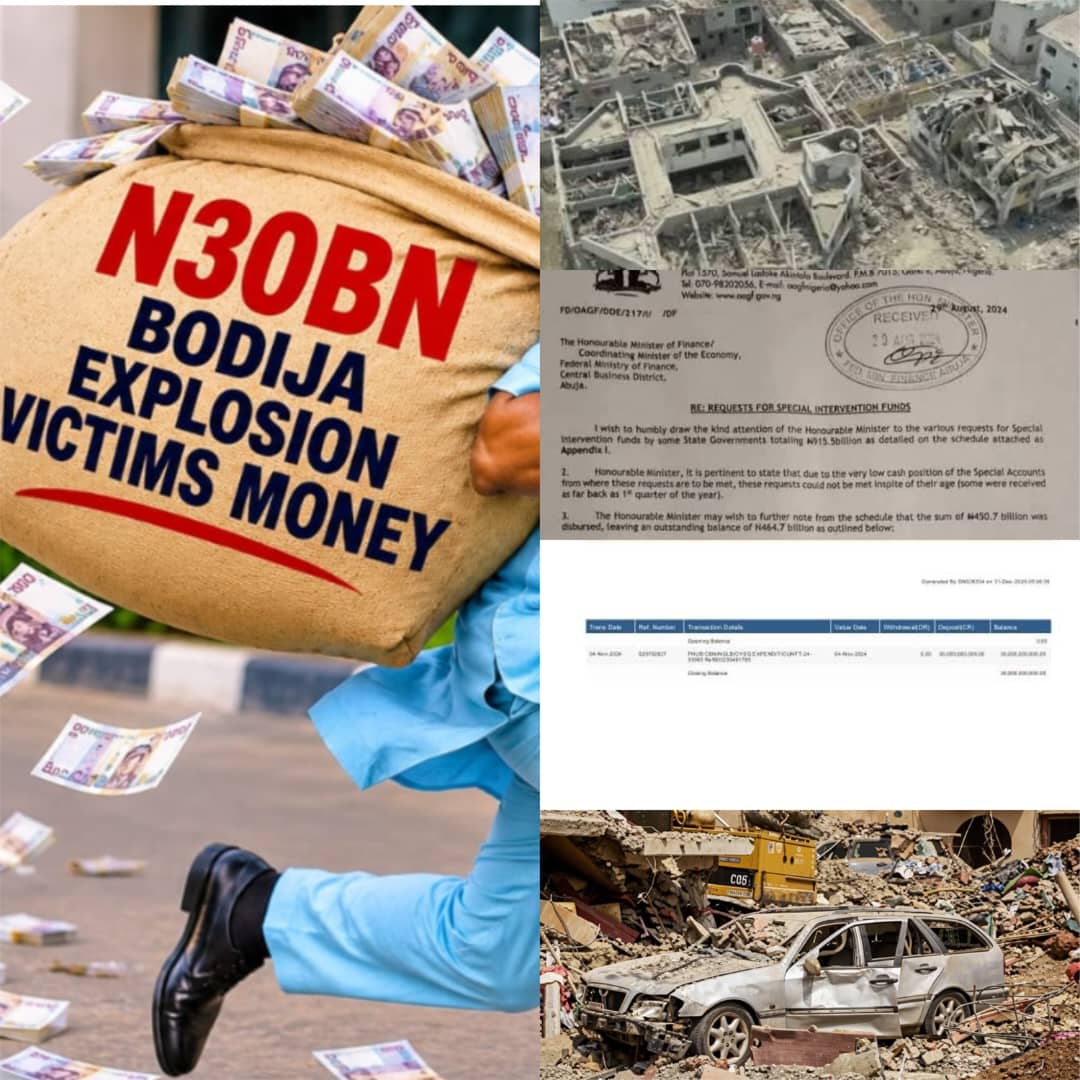
The management of the ₦30 billion Federal Government intervention fund released following the January 2024 Bodija explosion in Ibadan has attracted renewed public attention following a fresh explanation by Oyo State Governor, Engineer Seyi Makinde, that his administration has spent the money.
Makinde, who spoke during an interview with Arise Television, said the state government engaged the Nigerian Society of Engineers and professional valuers to assess properties affected by the explosion before providing financial support to their owners.
The governor’s disclosure represents a new development in the public discussion surrounding the intervention fund, particularly as the Oyo State Government had previously stated that the money remained untouched in a dedicated bank account.
Explaining how the intervention was handled, Makinde said, “We’ve spent the money. We got the Nigerian Society of Engineers, we got valuers, you know, they went out there, had the valuation of the properties, and then we gave money back to those people.”
He explained that the money had remained in the bank pending what he described as an anticipated attempt to use the Federal Government’s intervention fund as a political issue against his administration.
“It was in the bank until, because you know, when you know the people that you’re dealing with, people should ask, how come governors were defecting to APC? But me, I stood my ground,” he said.
The governor also spoke about what he considered attempts to use the fund to discredit his administration, saying he had anticipated that questions would eventually be raised about the money.
“Did they not try to blackmail me? We knew that they were going to get to that point where they will say, oh, we gave Oyo State this money. So I was waiting, and when they said it, I gave out my own report of that transaction,” Makinde stated.
He further disclosed that he had directed the Commissioner for Finance to deploy the money to projects after making his account of the transaction public.
“I instructed the Commissioner for Finance, please put this money now on project because they’ve done what we thought they were going to do,” the governor said.
The latest comments have renewed interest in the financial details of the intervention, including the compensation process, the amount paid to affected property owners and the projects to which the funds have been deployed.
The January 16, 2024 explosion in the Bodija area of Ibadan caused deaths, injuries and extensive damage to residential buildings, businesses and other properties.
Following the incident, Makinde wrote to President Bola Tinubu on January 19, 2024, requesting ₦100 billion in Federal Government assistance to address the impact of the disaster.
The Federal Government subsequently approved ₦50 billion, but the Oyo State Government later explained that it received ₦30 billion through the Central Bank of Nigeria on November 4, 2024, while the outstanding ₦20 billion had not been released.
The intervention fund subsequently became a subject of public discussion in December 2025 after former Ekiti State Governor, Ayodele Fayose, raised questions about its management.
Fayose alleged that the governor received ₦50 billion but released only ₦4.5 billion to victims, questioning the whereabouts of the balance.
In its response at the time, the Oyo State Government maintained that it received ₦30 billion rather than the full ₦50 billion and said the money remained in a dedicated First Bank account. It also reiterated that the outstanding ₦20 billion had not been released by the Federal Government.
In a statement issued on January 1, 2026, the state government said it had spent ₦24.6 billion from its own resources on the aftermath of the explosion.
According to the statement, the expenditure included ₦20.141 billion on infrastructure reconstruction and ₦4.085 billion on support and compensation for victims.
The government explained that these expenditures were separate from the Federal Government’s intervention fund, which it said remained in the dedicated account.
The state had also announced approval of ₦4.5 billion in May 2025 as financial support for survivors and victims, in addition to more than ₦200 million it said had been spent on accommodation, feeding, hospital bills and security following the explosion.
Despite the government’s explanations, some affected residents have raised concerns about aspects of the compensation process, including the assessment of damaged properties, the amounts received by beneficiaries and the circumstances surrounding buildings they say were not included in the exercise.
The Human and Environmental Development Agenda (HEDA) also petitioned the Economic and Financial Crimes Commission (EFCC), seeking an investigation into the receipt, management and utilisation of the intervention funds.
The petition and complaints from some affected residents have further highlighted the importance of public disclosure concerning the intervention.
With Makinde now stating that the ₦30 billion has been spent and that the Finance Commissioner has been directed to deploy the money to projects, further clarification on the specific projects funded, the amounts disbursed to property owners and the overall financial breakdown would help provide a clearer picture of the intervention.
The development has also generated political commentary amid discussions about the 2027 general elections and a possible presidential ambition. However, the management of the Bodija intervention fund remains a distinct public accountability issue that requires clear information from the relevant authorities.
For residents affected by the explosion, the priority remains the recovery of their communities, fair consideration of compensation concerns and access to verifiable information about the assistance provided.
Ultimately, a comprehensive public account of the intervention fund, including its disbursement and deployment, would help address outstanding questions and provide greater clarity for victims and other interested members of the public.