


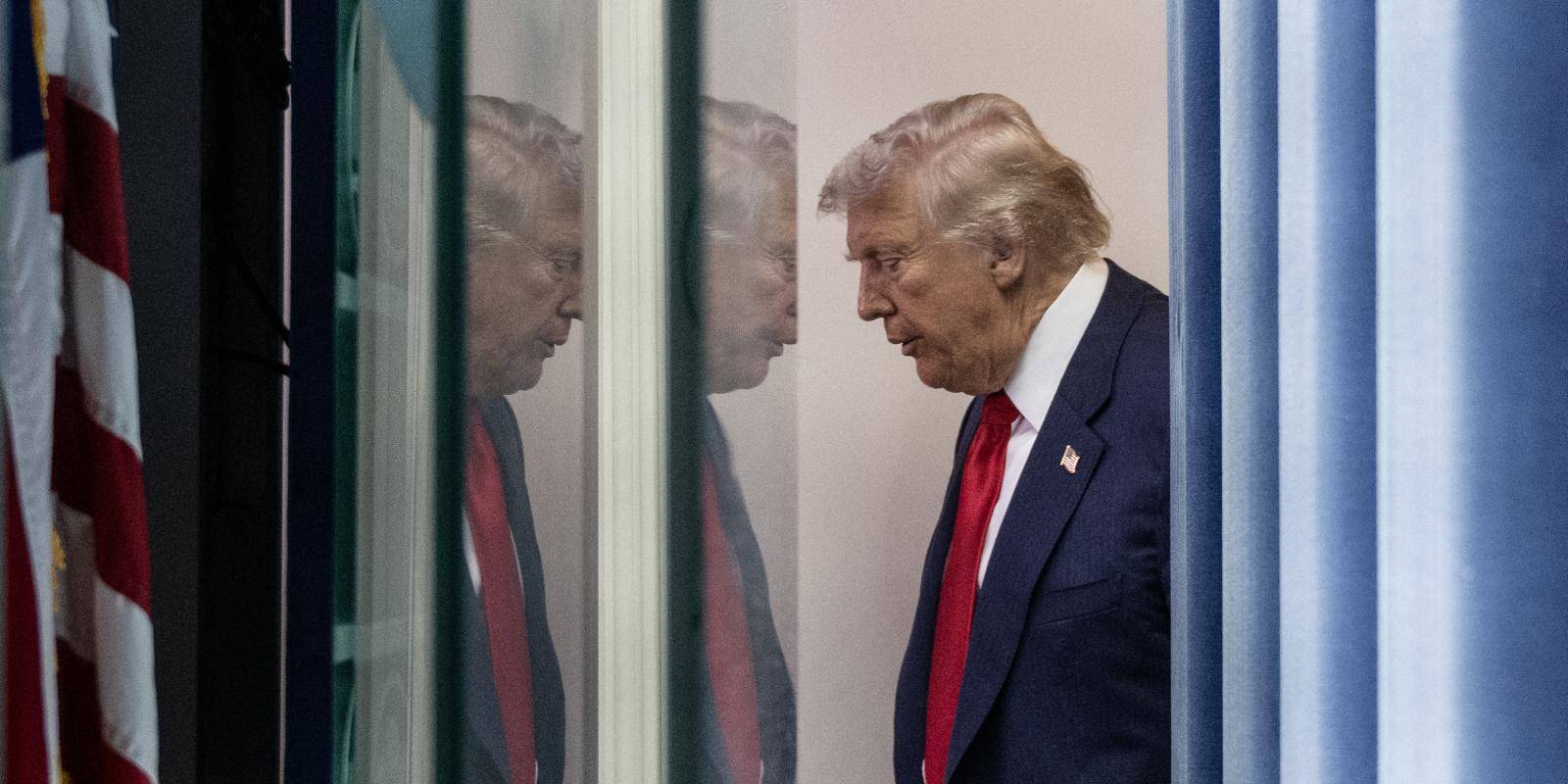
United States President Donald Trump has blamed the sharp decline in the country’s stock market on the electoral gains recorded by the opposition Democratic Party in the midterm elections held earlier this week.
Trump made the accusation on Thursday in a post on his Truth Social platform, following a major sell-off in US equities.
“The Stock Market crashed today because the Dumocrats had a big Tuesday — So sad to see, you only have yourselves to blame!” he wrote.
However, market analysts attributed the sell-off largely to concerns that the Democrats’ electoral gains could threaten investments in artificial intelligence (AI) data centres, amid growing opposition to such projects across the United States.
The technology-focused Nasdaq recorded its worst percentage decline in a single trading session since April 2025.
Data centre projects have faced increasing opposition from voters across party lines, with several candidates who won seats in the midterm elections pledging to restrict or slow down their development.
The Democrats recorded significant gains, flipping seats previously held by Republicans in South Carolina, North Carolina, Iowa, Kansas, Ohio, Texas and Maine.
In Maine, former logger Troy Jackson defeated longtime Republican Senator Susan Collins, securing the Democrats’ seventh Senate seat captured from Republicans.
In Kansas, Methodist minister Adam Hamilton became the first Democrat elected to the Senate from the traditionally conservative state since 1932, while Iowa elected a Democratic senator for the first time since 2008.
In Texas, Democrat Talarico declared that he had defeated “Goliath” after winning a Senate seat, while Gina Hinojosa unseated Republican Governor Greg Abbott, ending decades of Republican control of the governorship.
The Democrats also retained key Senate seats, including that of Jon Ossoff in Georgia, as well as an open seat in New Hampshire.
Their gains extended to Michigan, where Abdul El-Sayed defeated former Republican lawmaker Mike Rogers, becoming the first Muslim elected to the upper chamber of Congress.
In the House of Representatives, Democrats made gains across Pennsylvania, Kentucky, Arizona, North Carolina, Wisconsin and New Jersey, including in districts Trump had won comfortably in the 2024 presidential election.
In one closely watched contest in Indiana, Democrat J.D. Ford defeated Republican Congresswoman Victoria Spartz in a district Trump had carried by 17 percentage points in the 2024 presidential election.
The Democrats also won Georgia’s governorship, with former Atlanta Mayor Keisha Lance Bottoms making history as the state’s first Black woman governor.
Republicans, however, secured victories in Florida, where Trump-backed Byron Donalds became the state’s first Black governor, while Ashley Moody retained a Senate seat after overcoming a strong Democratic challenge.
The electoral outcomes have intensified political attention on the implications of the Democrats’ gains for Trump’s administration, particularly as investors assess the possible impact of shifting political priorities on major technology and infrastructure projects.