


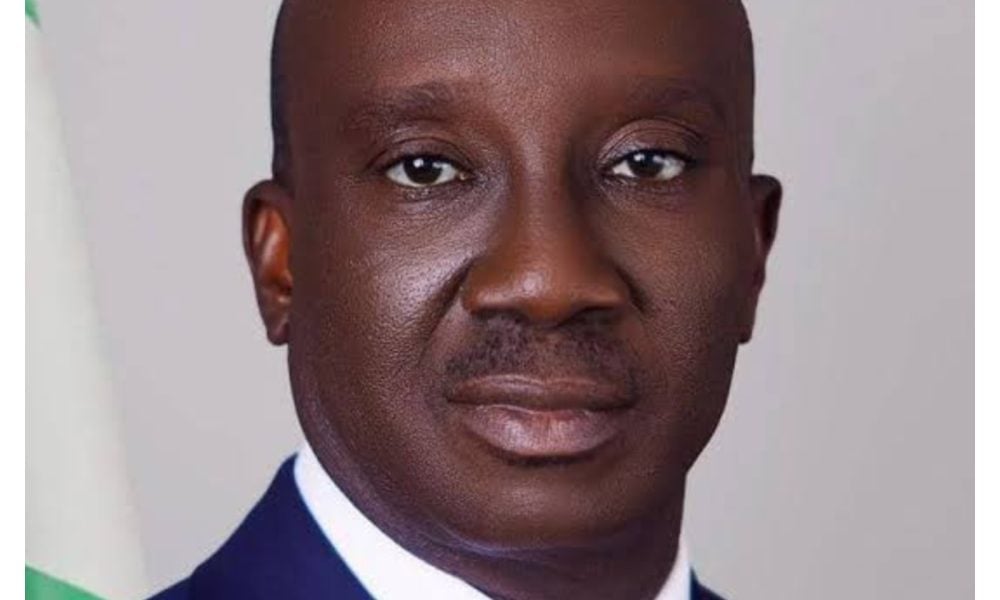
Fuel Price: APM, Labour Union Fault Okpebholo Over UK Comparison
Edo State Governor, Monday Okpebholo, has come under criticism over his comparison of petrol prices in Nigeria and the United Kingdom, with the Allied Peoples Movement and a labour unionist questioning the basis of his argument.
Okpebholo had said Nigerians should consider themselves fortunate that petrol currently sells for around N1,400 to N1,500 per litre, noting that the equivalent price in the United Kingdom was above N3,000 after currency conversion. He made the remark while speaking at the “Operation Rescue Benin-Asaba Road” event in Edo State.
The governor said he recently visited London and, alongside a friend, bought petrol to compare the price with what motorists pay in Nigeria. According to him, the price in the UK translated to more than N3,000 per litre.
“We are doing very well here because what we are seeing in Nigeria today is a reform. The reform that is ongoing is a very difficult one, and President Bola Tinubu is working to stabilise the country’s economy,” Okpebholo said.
The governor likened the ongoing economic reforms to an aircraft taking off, explaining that passengers would not be served food until the plane reached cruising altitude.
“When a plane is taking off, do you see them serving food? Do you see the air hostesses serving food in the plane? They will never give you food until the seatbelt is released.
“That means on a cruising level is when they will start serving food. I want to let you know that very soon Nigeria will be on a cruising level,” he said.
Okpebholo also expressed support for President Bola Tinubu’s continued stay in office ahead of the 2027 presidential election, declaring that Aso Rock was not vacant.
“Is Aso Rock vacant? No, Aso Rock is not vacant,” he said.
The comments have continued to generate debate, particularly over the relevance of comparing petrol prices without considering differences in income levels, purchasing power and economic conditions between Nigeria and the United Kingdom.
The Allied Peoples Movement, APM, also joined the debate, demanding Okpebholo’s resignation over what it described as an attempt to justify the high cost of petrol in Nigeria under the Tinubu administration.
In a statement by its National Publicity Secretary, Abubakar Yusuf, the party said it was inappropriate to compare petrol prices in Nigeria and the United Kingdom without considering the differences in income and purchasing power.
The APM said, “It is reckless and irresponsible for Okpebholo to say that Nigerians should not complain about the N1,500 per litre cost of fuel in the country because it is cheaper than an average N3,000 per litre cost in the United Kingdom, without taking into consideration the per capita income and purchasing power of an average Nigerian in comparison to a British citizen.”
The party further argued that the comparison failed to reflect the difference between the earnings of workers in both countries, as well as the cost and structure of public transportation.
According to the APM, the government should focus on policies capable of improving citizens’ purchasing power rather than compare domestic fuel prices with those of countries operating under different economic conditions.
The party also cited petrol prices in other oil-producing countries, including Libya and Iran, as part of its argument against using the United Kingdom as a benchmark for Nigeria.
The APM expressed concern that the governor’s comments could fuel apprehension over the possibility of further increases in petrol prices, although it presented the possibility as a concern rather than an established government plan.
Also reacting, labour unionist Abayomi Idowu described Okpebholo’s comments as insensitive, arguing that petrol prices should be considered alongside workers’ earnings and purchasing power.
Idowu questioned the basis for comparing fuel prices in Nigeria and the United Kingdom, stressing that the income levels of workers in both countries were substantially different.
“How can anybody compare the fuel price in Nigeria and the UK? Where do you even start the comparison?
“Does he know how much people receive in the UK as the minimum wage? With the minimum wage of N70,000 per month for an average Nigerian worker, the total annual emolument is not even up to a monthly minimum wage of a British worker. So, I can’t find any basis for that comparison,” he said.
He maintained that the focus of government should be on measures capable of reducing the burden of rising living costs on workers and households.
The controversy comes amid continuing concerns over petrol prices and the wider effects of the Federal Government’s economic reforms, which Okpebholo defended as difficult but necessary measures that he believes would eventually produce positive results.