


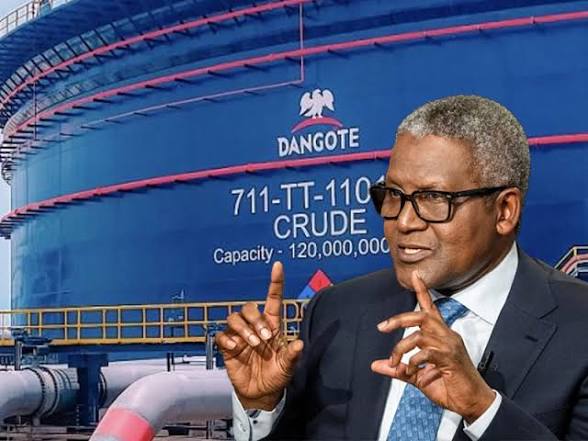
Dangote: Petrol Cheaper In Nigeria, Neighbours Pay 30% To 50% More
President of Dangote Industries Limited, Aliko Dangote, has said petrol remains relatively cheaper in Nigeria than in neighbouring countries, arguing that the price disparity is fuelling the smuggling of the product across the country’s borders.
Dangote made the statement on Tuesday during an interview with Arise Television while speaking on the recent increase in petrol prices across the country.
The businessman urged Nigerians to compare the domestic price of petrol with what consumers pay in neighbouring countries before concluding that the product is expensive in Nigeria.
He said petrol prices in some neighbouring countries were between 30 and 50 per cent higher than Nigeria’s, creating an incentive for smugglers to move the product across the borders for higher profits.
“Well, you know, the ‘expensive’ is relative. What they need to do is to ask what the neighbour’s price is,” Dangote said.
“I don’t know if you know that there’s still a lot of smuggling of the same petrol we are producing to our neighbouring countries because those neighbouring countries are about 30 per cent to 50 per cent more expensive than Nigeria. So it’s actually not like for like.”
Dangote explained that the price difference could make cross-border smuggling financially attractive, as traders could purchase petrol in Nigeria and sell it at higher prices in neighbouring countries.
He specifically cited Niger Republic, saying petrol was currently about 20 to 25 per cent more expensive there than in Nigeria.
“If the price even now is ₦1,350, the price in Niger is 20 to 25 per cent more than in Nigeria. So what business are you going to do that will make you a 25 per cent return?” he asked.
He said the price disparity could encourage the diversion of petrol meant for the Nigerian market to border communities, where it could be sold at a higher price.
Dangote also expressed concern about the possible impact of the ongoing crisis in the Middle East on the global energy market, warning that product availability could become a bigger concern than price.
He, however, assured Nigerians that the Dangote Refinery would continue to supply the domestic market and would work to prevent shortages.
“We will make sure that Nigeria will be fully delivered. Nigerians don’t need to worry,” he said.
“There will not be any shortage from our own part. There won’t be any shortage. There will not be any queues.
“And we’ll make sure that we keep satisfying the market.”
The comments came amid fresh increases in petrol pump prices across several parts of the country, with reports indicating that some filling stations in Lagos had raised their prices to about ₦1,400 per litre, while some outlets in Abuja were selling at around ₦1,450 per litre.
Dangote Identifies Policy Inconsistency, Poor Power Supply As Business Challenges
Speaking further, Dangote identified inconsistent government policies and inadequate electricity supply as two major challenges confronting businesses and manufacturers in Nigeria.
According to him, the cost of generating alternative power, particularly through diesel, has continued to put pressure on businesses and manufacturers.
“The greatest problem, there are two, which are still existing. One is inconsistencies in government policies. The second one is to do with lack of electricity,” he said.
Dangote argued that manufacturers could not sustainably depend on diesel-powered generators to run their businesses because of the high cost of the product.
“You cannot manufacture goods with diesel. You can see where diesel is today. You can’t even produce bread and make money today. So, we have to look at that today,” he said.
The billionaire also drew attention to Africa’s electricity deficit, saying hundreds of millions of people on the continent still lack access to reliable electricity.
“We must make sure, even for us, really, as Africans, we cannot sit down and see that everybody is complaining. 600 million of our people, they actually don’t have power,” he added.
He said the scale of the electricity challenge had encouraged some African business leaders to consider taking more direct steps towards addressing the continent’s power deficit.