


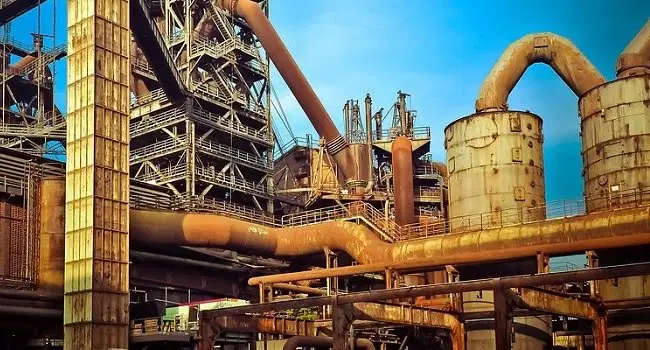
Steel imports bleed Nigeria’s economy
Nigeria spent more than N1 trillion on iron and steel imports in 2025, according to data from the National Bureau of Statistics, NBS.
The development comes despite the country’s abundant raw materials and the existence of the multi-billion-dollar Ajaokuta Steel Complex in Kogi State, which has remained largely idle for more than four decades.
The steel industry is widely regarded as the bedrock of industrialisation because of its importance to manufacturing, construction, transportation, infrastructure, defence and other strategic sectors.
Available NBS data showed that Nigeria’s iron and steel imports averaged about N526 billion annually over the past six years. In 2025 alone, however, the value exceeded N1 trillion, with the figures representing officially recorded trade and excluding possible unrecorded or under-reported imports.
The scale of the country’s dependence on imported steel is even higher according to the Minister of Steel Development, Prince Shuaibu Abubakar Audu, who has put Nigeria’s annual expenditure on iron and steel imports at an estimated $4 billion, equivalent to about N5.6 trillion.
Ajaokuta’s potential
The Ajaokuta Steel Complex was conceived as an integrated metallurgical complex capable of producing up to 5.2 million tonnes of liquid and finished steel products annually.
Its planned output included heavy plates, flat sheets, wire rods, bars, structural shapes and industrial chemical by-products.
Beyond meeting domestic demand, the complex was designed to supply steel to West African countries and, eventually, other African markets.
If fully operational, Ajaokuta could become one of the pillars of Nigeria’s industrial transformation, with analysts projecting hundreds of thousands of direct jobs and millions of indirect jobs across mining, engineering, manufacturing, construction, transportation and other sectors.
Domestic steel production could also reduce the country’s import bill, conserve foreign exchange and create opportunities for export earnings, while providing critical inputs for automobile manufacturing, road and rail construction, housing, machinery and fabrication.
Organised labour speaks
Speaking to Financial Vanguard on the state of the country’s steel sector, President of the National Association of Steel Workers, Oyabugbe Sunday, said Nigeria currently exports raw materials while importing finished steel products at significantly higher costs.
According to him, the situation limits domestic value addition, industrialisation and sustainable economic growth.
On the annual import bill, he said industry estimates put the country’s steel import expenditure at about $4 billion, although the exact figure fluctuates depending on import volumes and global market prices.
On the cost of reviving Ajaokuta, Oyabugbe said the last audit of the company reportedly indicated that the project was about 95 per cent complete and required approximately $1.5 billion to become operational.
Past failed attempts to revive Ajaokuta
Efforts to revive Ajaokuta through private-sector concessions have a long and troubled history, with successive arrangements under previous administrations ending in failure, controversy and prolonged legal disputes.
The first major concession came under the administration of former President Olusegun Obasanjo, which sought to revive the complex.
In June 2003, the Federal Government entered into a 10-year concession agreement with SOLGAS Energy Limited, an American company, to rehabilitate, complete, commission and operate the Ajaokuta Steel Complex.
The arrangement failed to deliver the expected results, and the government terminated the concession in 2004 over alleged non-performance.
The government subsequently turned to Global Infrastructure Nigeria Limited, GINL, linked to Indian steel magnate Pramod Mittal’s Global Steel Holdings.
In August 2004, GINL received a 10-year concession to rehabilitate, complete, manage and operate Ajaokuta. The transaction was heavily criticised over alleged lack of transparency, while the Bureau of Public Enterprises, BPE, which had the statutory mandate to privatise government companies, was reportedly not involved in the deals.
The arrangement later became one of the most controversial concession deals involving the complex.
In 2007, shortly before the end of the Obasanjo administration, the concession was converted into a share-sale agreement under which the Federal Government agreed to transfer 60 per cent of Ajaokuta Steel Company to GINL for $525 million.
The arrangement was subsequently subjected to scrutiny by the administration of late President Umaru Musa Yar’Adua following allegations surrounding the manner in which the concession had been handled.
An administrative panel was established in 2007, and the government terminated the concession in 2008, citing breaches of the agreement, including alleged asset stripping and failure to provide the required financing.
The dispute was taken to international arbitration in London by GINL and dragged on for several years, complicating subsequent efforts to attract a new investor or concessionaire.
The dispute continued through the administration of former President Goodluck Jonathan and into much of the eight-year tenure of former President Muhammadu Buhari.
Towards the end of Buhari’s administration, the Federal Government opted for an out-of-court settlement with the Indian company.
According to the report, the government paid $496 million in a negotiated settlement, said to have been reduced from an initial $5.27 billion legal claim, to end the dispute and fully reclaim the Ajaokuta Steel Complex.
Russia’s return to Ajaokuta
Following the Russia-Africa Summit hosted by Russian President Vladimir Putin in Sochi in October 2019, Nigeria secured a commitment from Russia to provide funding and technical expertise for the completion of Ajaokuta.
Russia and Ukraine, which were part of the former Soviet Union when the complex was constructed, offered technical support, while the Russian Export Centre pledged $460 million for the project.
The African Export-Import Bank, Afreximbank, also agreed to provide the balance of about $1 billion needed for the project.
However, despite the reported commitments, the agreement was not concluded before Buhari left office.
In May 2020, the government established the Ajaokuta Presidential Project Implementation Team, APPIT, to drive the process of completing and reviving the plant.
The team was chaired by the then Secretary to the Government of the Federation, Boss Mustapha, with the then Minister of Mines and Steel Development, Olamilekan Adegbite, serving as alternate chairman.
At its inauguration, Mustapha described Ajaokuta as a project that had remained economically unproductive for about four decades, resulting in what he called avoidable foreign exchange losses and missed economic opportunities.
He said the presidential intervention was aimed at redirecting the activities of the steel plant and bringing the project back to life to support Nigeria’s economic development and industrialisation.
Allegations of conflict of interest
However, the implementation team reportedly made limited progress amid allegations of conflict of interest among some members.
According to the report, some members allegedly sought to influence the selection of private companies as part of the Special Purpose Vehicle contractors under the proposed Build-Operate-Transfer arrangement.
The alleged move reportedly caused disagreements within the team and contributed to difficulties in advancing the project before the end of the Buhari administration.
Speaking earlier on the Russian arrangement, Adegbite said the government had sought a government-to-government partnership because previous commercial arrangements to complete Ajaokuta had failed.
He explained that the Russian Export Centre had pledged $460 million, while Afreximbank had indicated its readiness to provide about $1 billion.
Buhari’s failed concession attempt
Buhari’s administration also attempted to concession Ajaokuta again towards the end of his tenure, despite the earlier arrangement involving Russia and Afreximbank.
The proposed concession attracted criticism, particularly over concerns about transparency and the decision to move away from the earlier government-to-government arrangement.
The completion of Ajaokuta remains significant to Nigeria’s foreign exchange position, as domestic steel production could reduce the country’s dependence on imports while creating opportunities for exports.
Tinubu’s Ajaokuta campaign pledge
The revival of Ajaokuta was also a prominent promise during the 2023 presidential campaign.
While seeking votes in Kogi State, then presidential candidate of the All Progressives Congress, APC, Bola Tinubu, pledged to revive the Ajaokuta Steel Complex and develop the state’s mineral resources.
At an APC campaign rally in Lokoja, the Kogi State capital, Tinubu also promised to dredge the River Niger to facilitate shipping and inland water transportation in support of the steel industry.
He said: “Hope is here. Ajaokuta resuscitation will be done. Dredging of Niger River will be done. Agriculture will be the source of our prosperity. North Central has the potential for great mineral industrialisation; we will work on that.”
Three years into his administration, however, Ajaokuta remains largely idle, adding to the long history of unfulfilled promises surrounding the complex.
The continued dependence on imported steel has therefore kept pressure on Nigeria’s foreign exchange resources while leaving one of the country’s biggest industrial projects largely unproductive.