


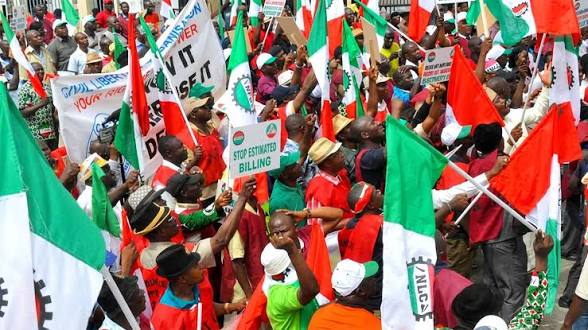
Fuel Hike: Labour, CSOs Accuse FG, Operators of Exploitation, Gang-Up
Organised Labour and Civil Society Organisations (CSOs) have accused the Federal Government and petroleum industry operators of contributing to the mounting hardship faced by Nigerian workers and other citizens through successive increases in petroleum product prices.
They also faulted the Federal Government for failing to exercise effective regulatory oversight over the downstream petroleum sector.
The development came as the Independent Petroleum Marketers Association of Nigeria (IPMAN) attributed the latest increase in petrol prices to repeated price adjustments by the Dangote Refinery.
Reacting to the latest increase in pump prices noticed across the country on Wednesday, the Nigeria Labour Congress (NLC) said the development was particularly troubling given the relative stability of crude oil prices in the international market and recent improvements in the exchange rate environment for local businesses whose cost factors are denominated in United States dollars.
Faulting the increase, NLC Assistant General Secretary, Chris Onyeka, alleged that there was a “gang-up” against Nigerians by the elite, allegedly with the support of the ruling class.
“There is a gang-up against Nigerian masses by the elite, unfortunately with the seeming support of the ruling class.
“The truth is that the price of crude has remained stable, but the exchange-rate regime has become slightly favourable for local businesses whose cost factors are measured in United States dollars.
“The only justification for increasing petroleum product prices can only be seen from the standpoint of capitalist greed, reaping the benefits of extortionate monopoly.
“A few dominant operators have become the major suppliers of petroleum products to the Nigerian market and are always ruthless in exploiting any opportunity to increase prices whenever it presents itself, especially when the regulators in the industry have remained worryingly silent.”
Onyeka said the situation demonstrated the dangers of allowing monopolistic tendencies to thrive in the petroleum sector.
“It shows you the dangers of courting monopolies, which countries do everything to destroy but which monsters Nigeria seems to be comfortable breeding.
“Every Nigerian remembers how much we pay for a bag of cement, a product controlled by the same dominant operators.
“There will be no respite for Nigeria from the exploitation of a dominant operator until we get our public refineries back on stream.
“We have spoken of these dangers at the beginning, and this will continue if the government does not wake up through its agencies that regulate the sector to rein in the dominant operators’ appetite for exploitation.
“This is coming at the heels of the widely known fact that Nigeria experienced the highest level of petroleum price hike as a result of the Iran-US/Israeli war globally.
“We must ensure that the stranglehold which these guys have on our downstream sector is removed if government is truly committed to reducing the hardship on workers and the masses.
“Unfortunately, it appears that government is not interested in alleviating the sufferings of the people.”
CSOs back NLC
Corroborating the NLC’s position on the alleged collusion between the Federal Government and oil marketers, Civil Society Organisations insisted that Nigerians deserved better in the downstream petroleum sector.
The Human Rights Writers Association of Nigeria (HURIWA) said the government appeared more concerned about protecting business interests in the oil sector than addressing the welfare of citizens.
National Coordinator of HURIWA, Emmanuel Onwubiko, stated this in a telephone interview, saying Nigerians were paying the price for what he described as the government’s “disproportionate interest” in the comfort of the oil cabal.
“The NLC is spot on. How can you explain why the only oil refinery in Nigeria and those who import petroleum products are selling at almost the same price?
“This doesn’t make sense. Something is deeply wrong and the excuse that it is a free market is not adding up. The prices are supposed to be competitive and Nigerians ought to enjoy lower prices if things were done properly.”
Consumer protection agencies, others need to protect Nigerians now — CISLAC
Also speaking, Executive Director of the Civil Society Legislative Advocacy Centre (CISLAC), Auwal Musa Rafsanjani, said the latest increase in the pump price of Premium Motor Spirit (PMS) was a matter of serious concern, particularly because Nigerians were already struggling with high transportation costs, food inflation and declining purchasing power.
“We view the latest increase in the pump price of PMS with serious concern, particularly because Nigerians are already struggling with high transportation costs, food inflation, declining purchasing power and the broader consequences of previous energy-price increases.
“Our position is that Nigerians should not be made permanent victims of a deregulated petroleum sector that socialises every increase in cost while privatising every reduction in cost.
“Government must intervene as a regulator and protector of competition, not necessarily as a price fixer. It should immediately establish whether the present increases are supported by genuine market conditions.
“Deregulation must not become another word for exploitation. Its promise should be competition, efficiency, transparency and ultimately better value for Nigerian consumers.
“We recognise that Nigeria operates a deregulated downstream petroleum market. Deregulation means that the government should not arbitrarily dictate the price at which every marketer sells petrol. However, deregulation cannot mean the absence of regulation, transparency or consumer protection.
“A deregulated market must be genuinely competitive. It cannot become a system in which prices increase immediately whenever there is an upward movement in costs but remain rigid whenever crude prices, exchange rates or ex-depot prices decline.
“We call on the NMDPRA, Federal Competition and Consumer Protection Commission (FCCPC), Ministry of Petroleum Resources and other relevant institutions to immediately conduct an evidence-based review of the current PMS pricing template.
“Marketers and major suppliers should be required to transparently demonstrate the components responsible for significant price adjustments, including the ex-refinery or ex-depot price, exchange-rate exposure, transportation, financing, storage, insurance, distribution margins and applicable taxes or levies.
“We are particularly concerned about a pattern in which consumers appear to experience rapid upward price transmission but extremely slow downward transmission.
“Government should also investigate whether there is any evidence of price fixing, coordinated pricing, market dominance, artificial scarcity or other anti-competitive practices.
“We call for the following measures: immediate pricing audit, with the NMDPRA publishing a transparent assessment explaining the cost components responsible for the latest PMS price increases; and mandatory price transparency, with major refiners, depot owners and marketers disclosing the key components informing ex-depot and retail price adjustments without revealing legitimate commercially sensitive information.”
Govt needs to urgently intervene — ActionAid
ActionAid Nigeria Country Director, Dr Andrew Mamedu, also expressed concern over the latest increase, saying every rise in petrol prices quickly translates into higher transportation costs, food prices and pressure on household incomes.
“We are concerned about the recent increase in petrol prices because every increase at the pump quickly affects transportation, food prices, businesses and household income.
“What deserves scrutiny is that prices are rising at a time when some of the factors usually cited, including global crude prices and the exchange rate, have shown relative stability. Nigerians therefore have a legitimate question: what exactly is driving the increase?
“We recognise that Nigeria operates a deregulated petroleum market and prices will reflect crude costs, refining, foreign exchange, transportation, distribution and reasonable business margins. But deregulation must not become a licence for arbitrary pricing or profiteering.
“The FCCPC has previously raised concerns that marketers are often quick to increase prices when crude prices rise, but reductions are not passed to consumers at the same speed when costs fall. That is an issue regulators must examine seriously.
“Government can and should intervene, not necessarily by fixing prices, but by ensuring transparency and protecting consumers. The NMDPRA and FCCPC should examine the pricing chain from refinery to filling station and make clear what is driving these increases. Where there is evidence of price fixing, collusion, artificial scarcity or excessive profiteering, regulators must act.
“The renewed conversation around fuel subsidy also presents an important opportunity. If government maintains that a universal petrol subsidy is inefficient or unsustainable, then we must have an equally serious conversation about targeted support for people living in poverty and those most vulnerable to these price increases.
“Support can take other forms: affordable public transportation, targeted social protection, support for smallholder farmers, energy assistance for low-income households and measures that reduce the cost of moving food and essential goods.
“The principle should be simple: removing a general subsidy should not mean removing government’s responsibility to cushion the poorest from economic shocks. Savings from reforms should translate visibly into stronger protection and better public services for those who need them most.
“For us, the biggest concern is the impact on ordinary Nigerians. A small increase in petrol can mean higher transport fares, higher food prices and greater pressure on families already struggling with the cost of living.
“Our position is clear: Nigerians should not continue to bear unexplained increases in the cost of essential commodities.
“Businesses have a right to make reasonable profits, but citizens also have a right to protection from exploitation.
“Deregulation cannot mean deregulating responsibility. Government must protect the public interest, regulators must regulate effectively, and economic reforms must work for those living in poverty, not push them further behind.”
Why fuel price is high — IPMAN
Meanwhile, IPMAN attributed the latest increase in petrol prices to repeated price adjustments by the Dangote Refinery.
Public Relations Officer of IPMAN, Chief Chinedu Ukadike, said marketers had had to contend with frequent adjustments in gantry prices over the past week.
According to him, the refinery raised its gantry price from N1,165 per litre to N1,185 and subsequently to N1,200 per litre within seven days.
“Every time Dangote increases his price, our price will also rise,” he said, adding that independent marketers were being forced to adjust their pump prices because they could not continue selling at a loss.
The latest development has been reflected in pump prices across Abuja.
Checks around the Federal Capital Territory yesterday showed that NNPC Retail stations, which previously sold petrol at N1,250 per litre, were now selling at N1,270 per litre. TotalEnergies prices had moved from N1,250 to N1,275 per litre, while Bovas stations had adjusted prices from N1,253 to about N1,275 per litre.
Ukadike said the volatility was making it difficult for marketers and consumers to plan, noting that the cost of replacing products could change significantly within a short period.
He attributed fluctuations in petrol prices to several factors, including international crude oil prices and movements in the foreign exchange market, as well as geopolitical developments affecting global oil supplies.
The IPMAN spokesperson said petrol price volatility was particularly significant because petroleum products have a direct influence on transportation and the wider cost of goods and services in Nigeria.
He, however, expressed optimism that the Dangote Refinery’s free transportation initiative for marketers could help ease distribution challenges and ultimately reduce prices if sustained.
According to him, some trucks carrying products under the scheme had yet to arrive because of poor road conditions, but more marketers were enrolling in the programme.
He said the inclusion of Imo and Anambra states in the initiative would also expand access to Dangote’s products, describing the two states as important gateway markets in the South-East.
Ukadike said increased access to locally refined products would intensify competition and reduce pressure on marketers facing transportation challenges and funds tied up in depots.
On the continued importation of petrol by some major marketers despite increased local refining capacity, Ukadike said imports could support deregulation and competition but questioned the rationale for importing products at prices higher than locally refined petrol.
“When the products that are being imported are higher than the ones Dangote is giving us, what is the essence of importing it, putting pressure on our dollar?” he asked.
He called for greater support for local refining, including increased access to crude oil for domestic refineries, arguing that stronger local production could eventually enable Nigeria to export refined petroleum products.
Source: Vanguard