


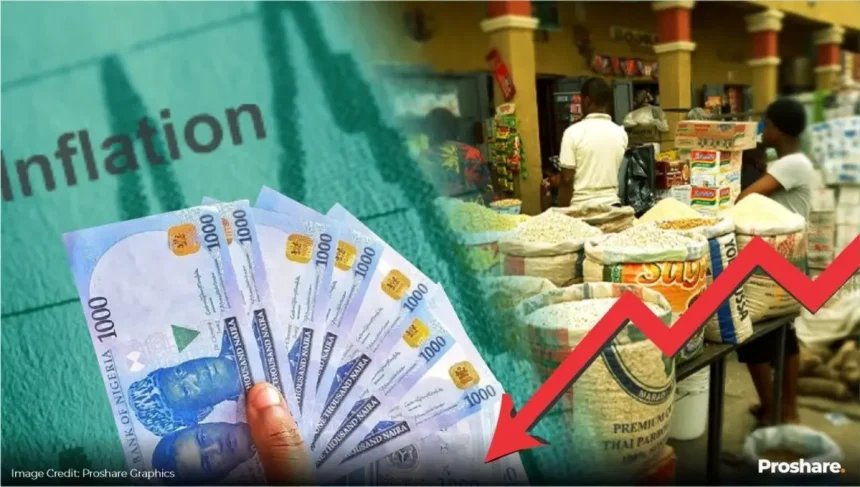
Nigeria’s Headline Inflation Drops to 15.43% in July 2026 — NBS
Nigeria’s headline inflation rate declined to 15.43 per cent in July 2026, representing a decrease from the 15.91 per cent recorded in June, according to the latest Consumer Price Index (CPI) report released by the National Bureau of Statistics (NBS).
The NBS disclosed this in a statement signed by the Statistician-General of the Federation, Prince Adeyemi Adeniran, on Monday.
According to the Bureau, the July figure also represented a significant decline compared with the 24.94 per cent recorded in July 2025.
The NBS stated that on a month-on-month basis, headline inflation stood at 1.57 per cent in July 2026, down from 1.66 per cent recorded in June, representing a decrease of 0.09 percentage points.
The Bureau attributed the movement in the inflation rate largely to changes in the prices of food and non-alcoholic beverages, restaurants and accommodation services, and transport.
At the divisional level, Food and Non-Alcoholic Beverages contributed 6.18 per cent, followed by Restaurants and Accommodation Services at 1.99 per cent and Transport at 1.64 per cent.
The least contributors to the headline inflation rate were Recreation, Sport and Culture at 0.05 per cent; Alcoholic Beverages, Tobacco and Narcotics at 0.06 per cent; and Insurance and Financial Services at 0.07 per cent.
Food inflation remains high
Despite the overall decline in headline inflation, food inflation remained elevated, standing at 20.31 per cent year-on-year in July 2026, although this was lower than the 26.20 per cent recorded in July 2025.
On a month-on-month basis, however, food inflation increased to 5.56 per cent in July, up from 3.75 per cent in June, representing an increase of 1.82 percentage points.
The NBS attributed the movement in food prices to changes in the average prices of commodities including crayfish, fresh pepper, onions, carrots, rice, water yam, tomatoes, garri, plantain, beef, eggs, guinea corn, ginger and plantain flour, among others.
Meanwhile, core inflation, which excludes volatile agricultural produce and energy prices, stood at 14.97 per cent year-on-year in July 2026.
On a month-on-month basis, core inflation declined to 0.15 per cent, compared with 1.66 per cent recorded in June.
The NBS said the July inflation figures across major sub-indices showed monthly changes of 4.66 per cent for farm produce, -2.39 per cent for energy, 0.49 per cent for services, 1.70 per cent for goods and 1.19 per cent for imported food.
Urban, rural inflation
The Bureau further reported that the urban inflation rate stood at 16.12 per cent year-on-year in July 2026, while the month-on-month rate declined to 1.90 per cent from 2.13 per cent in June.
In the rural areas, inflation stood at 13.77 per cent year-on-year, while the month-on-month rate increased to 0.78 per cent from 0.52 per cent in June.
According to the NBS, the highest year-on-year headline inflation rates were recorded in Adamawa at 33.03 per cent, Yobe at 25.21 per cent and Anambra at 23.99 per cent.
The lowest year-on-year headline inflation rates were recorded in Nasarawa at 7.86 per cent, Kebbi at 9.12 per cent and Borno at 9.12 per cent.
On a month-on-month basis, Adamawa recorded the highest increase at 12.48 per cent, followed by Anambra at 9.95 per cent and Delta at 9.54 per cent. Niger, Enugu and Kebbi recorded declines of 5.86 per cent, 5.71 per cent and 4.89 per cent respectively.
Food inflation highest in Adamawa
For food inflation, Adamawa recorded the highest year-on-year rate at 51.36 per cent, followed by Katsina at 30.84 per cent and Zamfara at 30.65 per cent.
Borno recorded a negative food inflation rate of -0.31 per cent, while Nasarawa and Kebbi recorded 6.88 per cent and 12.50 per cent respectively.
On a month-on-month basis, food inflation was highest in Adamawa at 17.02 per cent, Lagos at 13.48 per cent and Borno at 13.26 per cent.
Jigawa, Kebbi and Bauchi, however, recorded declines of 3.68 per cent, 3.67 per cent and 1.85 per cent respectively.
The NBS also explained that the latest CPI report followed the completion of the recent rebasing exercise, with the index now using 2024 as the base year and 2023 as the weight reference period.
The Bureau said the Consumer Price Index increased to 145.3 in July 2026, representing a 2.2-point increase from the preceding month.
The decline in headline inflation, while providing some relief, comes amid continued pressure from food prices, highlighting the mixed nature of Nigeria’s current inflationary environment.