


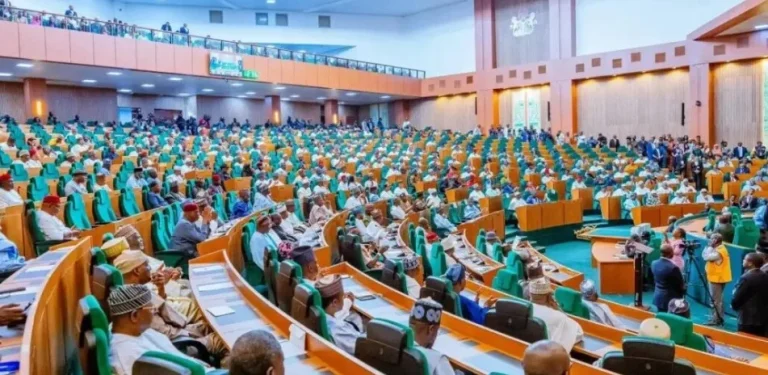
The President Seems Powerful: Reps in rowdy session over motion to summon Tinubu
The House of Representatives descended into a rowdy session on Wednesday as lawmakers clashed over a motion seeking to invite President Bola Tinubu to explain the alleged non-funding of constituency projects and the slow implementation of the 2026 budget.
The heated debate followed the consideration of a motion sponsored by the member representing Aba North/Aba South Federal Constituency, Abia State, Alex Ikwechegh, who lamented what he described as poor funding of approved budgets and persistent delays in the release of capital funds to Ministries, Departments and Agencies (MDAs).
Earlier, the member representing Okpe/Sapele/Uvwie Federal Constituency of Delta State, Benedict Etanabene, had raised a constitutional point of order, informing the House that he had seen a circular from the Office of the Accountant-General of the Federation suspending funding for zonal intervention projects pending fresh verification requirements.
The motion sharply divided lawmakers, with members across party lines expressing concern over what they described as the slow implementation of projects approved by the National Assembly. Although the motion received overwhelming support, attempts by some lawmakers to oppose parts of it were drowned out by loud protests, forcing Speaker Tajudeen Abbas to repeatedly restore order.
Presenting the motion titled, “Urgent Need to Address the Poor Funding of Appropriated Budgets and Delayed Releases to MDAs as Revealed During the 2026 Budget Defence Sessions,” Ikwechegh argued that the credibility of the appropriation process depends not only on the passage of budgets but also on the timely release and utilisation of funds.
He said disclosures made by ministers and heads of MDAs during the 2026 budget defence revealed that several agencies received little or no capital releases under the 2025 budget, leaving many critical projects abandoned despite legislative approval.
The lawmaker also recalled repeated protests by indigenous contractors over unpaid certificates for completed government projects, noting that many contractors had become unable to repay loans secured to execute federal contracts.
Ikwechegh further reminded the House that President Tinubu, during a Federal Executive Council meeting on December 10, 2025, directed the immediate settlement of verified contractor liabilities estimated at about ₦1.5 trillion and approved the establishment of an inter-ministerial committee to reconcile records and facilitate payment.
According to him, the National Assembly also approved borrowing in excess of ₦1 trillion to settle verified contractor obligations, while the 2026 Appropriation Act made provisions for outstanding liabilities. However, he expressed concern that despite these approvals and assurances by the Minister of Finance, releases to MDAs had remained slow, stalling projects, increasing contract costs and eroding public confidence in the budget process.
Ikwechegh also criticised a Treasury circular dated June 29, 2026, reportedly issued by the Office of the Accountant-General of the Federation, which requires a Certificate of Verification and Compliance from the Federal Ministry of Special Duties and Intergovernmental Affairs before payments can be made for constituency projects.
He argued that the directive, though well-intentioned, introduced another layer of bureaucracy capable of delaying already approved and executed projects.
The lawmaker urged the House to commend President Tinubu for directing the settlement of verified contractor liabilities while also appealing to him to appear before lawmakers alongside relevant officials to explain the slow implementation of the budget.
Earlier, Etanabene had urged the House to invoke its constitutional oversight powers by inviting the President and members of his economic team to explain the reported suspension of funding for constituency projects.
Relying on Sections 4, 88 and 89 of the 1999 Constitution (as amended), he maintained that the National Assembly had a constitutional responsibility to demand accountability over the implementation of budgets it approved.
He lamented that Nigerians could no longer be properly informed about the status of constituency projects, adding that the country was simultaneously implementing the 2024, 2025 and 2026 budgets, a situation he described as unacceptable.
However, Speaker Abbas ruled that the proposal seeking to summon the President could not be adopted, describing such a move as inconsistent with parliamentary practice.
He held that the aspect of the motion seeking to summon President Tinubu was “unparliamentary” and therefore inadmissible.
The House subsequently adopted the substantive resolutions of the motion, urging the Federal Ministry of Finance, the Budget Office of the Federation, the Office of the Accountant-General of the Federation and the Central Bank of Nigeria to prioritise the timely release and cash-backing of appropriated funds.
Lawmakers also called on the relevant agencies to publish a clear schedule for the release of funds under the 2026 fiscal year and conclude the verification and settlement of outstanding contractor liabilities within a publicly announced timeframe.