


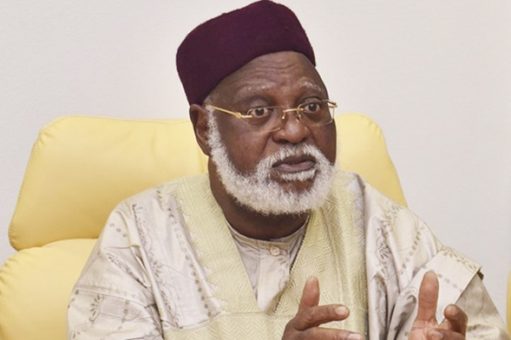
Abdulsalami Abubakar: Niki Tobi Committee Did Not Draft 1999 Constitution
…Says panel only coordinated nationwide debate on constitutional draft
Former Head of State, General Abdulsalami Abubakar (retd.), has dismissed the long-held belief that the committee headed by the late Justice Niki Tobi drafted Nigeria’s 1999 Constitution, insisting that the panel’s mandate was limited to coordinating a nationwide debate on an existing constitutional draft.
Abdulsalami made the clarification in his autobiography, Call of Duty: My Autobiography, where he chronicled the events that led to Nigeria’s return to democratic rule in 1999 and the emergence of the current Constitution.
In Chapter 23 of the book, titled “The Making of the 1999 Constitution,” the former military ruler said critics who claim that the Justice Niki Tobi-led committee authored the Constitution have misunderstood the committee’s role in the transition process.
“I need to re-emphasise here that their job was not to write a new Constitution but to coordinate a debate on the draft. I have heard many critics say the Niki Tobi Committee was set up to write a new Constitution. That is absolutely false,” Abdulsalami stated.
He explained that when he assumed office in June 1998 following the death of General Sani Abacha, his primary objective was to return the country to democratic governance as quickly as possible and end prolonged military rule.
According to him, his administration considered several options, including continuing with Abacha’s transition programme, initiating an entirely fresh constitutional process, or modifying the constitutional draft produced by the 1994/95 National Constitutional Conference.
Abdulsalami noted that continuing with Abacha’s transition programme was not viable because it lacked broad national acceptance, particularly among pro-democracy groups and influential political stakeholders in the South-West, who viewed it as a strategy to perpetuate military rule.
He also rejected calls for a fresh constitutional conference, arguing that such an exercise could have prolonged military rule for years and created opportunities for anti-democratic elements within the military to derail the transition.
“I reasoned that the longer the military stayed in power after Abacha’s death, the bleaker the prospects of a genuine transition to democracy would be,” he wrote.
The former Head of State said his government eventually adopted what he described as a middle-ground approach by abandoning Abacha’s transition programme while subjecting the 1995 Draft Constitution to extensive public scrutiny.
To facilitate the process, the administration established a 25-member Constitution Debate Coordinating Committee (CDCC), chaired by Justice Niki Tobi, with Dr. Suleiman Kumo serving as deputy chairman.
According to Abdulsalami, the committee’s mandate was to coordinate debates, receive memoranda and collate recommendations from Nigerians using the 1995 draft as a working document.
The committee subsequently organised public hearings across the country, including in Benin, Enugu, Jos, Port Harcourt, Maiduguri, Kaduna, Kano, Ibadan, Lagos and Sokoto. The draft constitution was also published in national newspapers to encourage wider public participation.
He disclosed that the committee received 405 memoranda from individuals, professional associations, political groups, ethnic organisations and Nigerians living in the diaspora.
While opinions were sharply divided—with some groups demanding that the draft be discarded and others insisting it remain unchanged—Abdulsalami said the committee’s review of submissions eventually produced a consensus that shaped the nation’s constitutional future.
Quoting from Justice Tobi’s report, he said Nigerians overwhelmingly favoured a return to the 1979 Constitution with necessary amendments rather than the wholesale adoption of the 1995 draft.
“The common denominator in the mouths of Nigerians the world over is the 1979 Constitution with relevant amendments,” the report stated.
Abdulsalami said the recommendation came as a welcome relief because it offered a constitutional framework capable of attracting broad national acceptance and preventing another political crisis.
He admitted that reverting to the 1979 Constitution had not initially occurred to him but became an attractive option after studying the committee’s findings. According to him, the 1979 Constitution emerged from extensive deliberations by the 1977/78 Constituent Assembly and was generally regarded as a credible and widely accepted legal framework.
The former military leader also pointed out what he described as an irony in the current debate over the Constitution, noting that many of its fiercest critics today actively participated in discussions surrounding the 1979 Constitution and even contested elections conducted under it.
“It is ironic that many of those vociferously campaigning against the 1999 Constitution participated in the debate over the 1979 Constitution and even ran for various elections under it,” he wrote.
Abdulsalami revealed that the Provisional Ruling Council eventually adopted the committee’s recommendation and updated the 1979 Constitution to reflect changes that had occurred since the Second Republic.
Among the key amendments were provisions accommodating the increased number of states and local government areas, as well as the establishment of the National Judicial Council (NJC) to strengthen judicial independence.
He further disclosed that the 13 per cent derivation principle for oil-producing states—one of the most significant provisions of the 1999 Constitution—was adopted from recommendations contained in the 1995 draft constitution.
The former Head of State maintained that the constitutional process adopted by his administration helped avert fresh political tensions and ensured a smooth transition to civilian rule within a relatively short period.
He reiterated that his government never intended to draft an entirely new constitution, but rather sought to provide Nigerians with an opportunity to debate, refine and improve existing constitutional proposals before the restoration of democratic governance in 1999.