

FG to Launch Nationwide Digital Switchover on June 17, Says Minister
The federal government has announced that Nigeria’s long awaited Digital Switchover (DSO) programme will officially launch nationwide on June 17, marking a major step in the country’s transition from analogue to digital broadcasting.
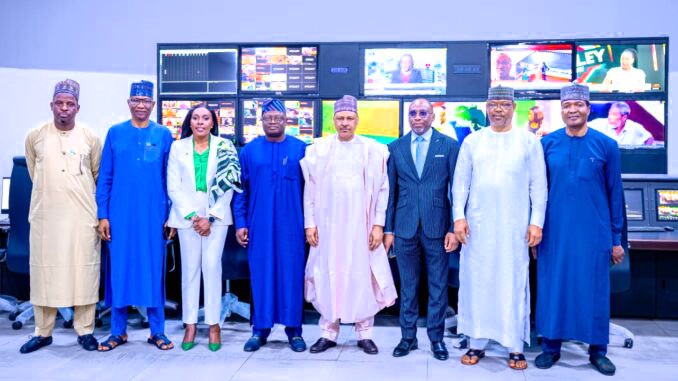
Minister of Information and National Orientation, Mohammed Idris, disclosed this on Wednesday after inspecting facilities linked to the project at Nigerian Communications Satellite Limited.
Describing the development as a significant reform in Nigeria’s broadcasting industry, Idris said the migration from analogue to digital transmission would provide substantial benefits for broadcasters, advertisers, and television viewers across the country.
“For many years, Nigerians have been grappling with the idea of the Digital Switchover. Now, it is finally here and ready to be commissioned on June 17 this year,” the minister said.
He explained that multiple television channels had already been unbundled on the platform, giving viewers access to a wider range of content while enabling advertisers to make data driven decisions through audience measurement technology.
“Science is now at play. We can now determine who is watching a particular station and how many people are tuning in. The standard measurement that was absent in previous attempts is now available,” he stated.
According to Idris, the platform would allow advertisers to identify target audiences across different demographics, improving advertising efficiency and creating more revenue opportunities for broadcasters.
The minister attributed the success of the initiative to the collaboration among NigComSat, the National Broadcasting Commission (NBC), the Ministry of Communications, and the Ministry of Information and National Orientation.
He also commended President Bola Ahmed Tinubu for providing the support and resources required to actualise the project.
“It has been unfortunate that Nigeria could not achieve this in the past, but now the digital switchover is finally here. Nigerians can now access free television services and watch content in real time,” he added.
Responding to questions on whether the platform was intended to replace pay television providers such as MultiChoice’s DStv, Idris said the initiative was designed to expand access and encourage competition within the broadcasting industry.
“I would not necessarily describe it as a substitute, but it offers opportunities for Nigerians to access services they could not get before. The monopoly has been broken, and competition will now increase,” he said.
According to the minister, increased competition would drive content growth, expand viewership, and create additional economic opportunities for broadcasters and advertisers.
Idris further disclosed that the platform currently operates on Standard Definition (SD) but would soon migrate to High Definition (HD), offering picture quality comparable to global standards.
He added that viewers would also be able to access the service through mobile applications and satellite coverage across Sub Saharan Africa wherever NigComSat services are available.
Speaking on lessons from previous DSO attempts, the minister said the current administration had resolved issues related to encrypted set top boxes and high subscription costs.
“In the past, the boxes were encrypted and expensive. Now, the service is free because the government has absorbed some of the costs on behalf of Nigerians,” he explained.
He also noted that unlike earlier pilot schemes limited to about eight cities, the new rollout would provide wider nationwide coverage through satellite technology.
The minister described the project as “very encouraging” after inspecting the satellite infrastructure supporting the initiative and assured Nigerians that the government would continue improving the service.
Also speaking, Jane Egerton Idehen, Managing Director and Chief Executive Officer of NigComSat, said the collaboration among relevant agencies had been instrumental to the success of the initiative.
She described the development as a major breakthrough for Nigeria’s broadcasting industry, noting that the new system would provide Nigerians with free to air television services with improved accessibility and quality.
Egerton Idehen also disclosed that the platform would transition from Standard Definition to High Definition, with additional upgrades already being planned.
“Competition among broadcasters is expected to increase as more channels and content providers join the platform, creating greater opportunities for local content development and advertising revenue generation,” she said.
According to her, the service would no longer be restricted to a few cities, as was the case during earlier pilot phases of the DSO project.
“Satellite technology and mobile applications will ensure wider coverage across Nigeria and parts of Sub Saharan Africa,” she added.
She further revealed that the platform is expected to host 100 channels by the launch date, with more content producers already in discussions to join.
“To support users, regional studios have been established across the country to assist content creators, while a multilingual national call centre offering support in English, Hausa, Yoruba, Igbo, and Pidgin English is also being introduced,” she said.
On his part, Charles Ebuebu, director general of the National Broadcasting Commission, said the upgraded DSO framework was designed to align with emerging technologies and modern viewing habits.
He explained that the new system leverages satellite broadcasting and mobile applications to ensure wider accessibility beyond the pilot cities covered during earlier DSO experiments.
“We are going to have 100 channels by the launch date and even more because additional content producers are already engaging with us. We want to create one market and one platform for Nigeria,” Ebuebu said.