


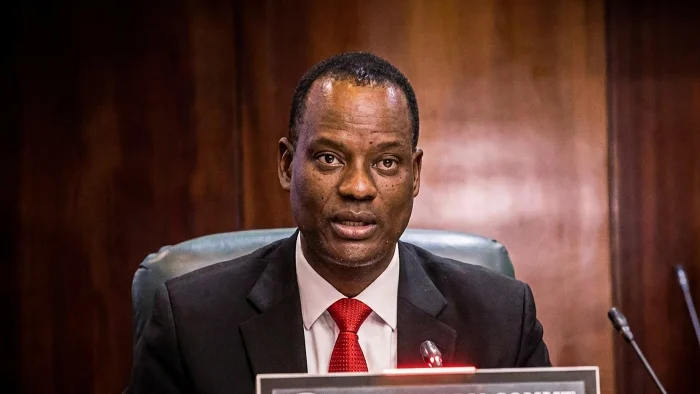
Nigeria’s 2030 $1tr economy on course, says Oyedele
The Minister of Finance and Coordinating Minister of the Economy, Taiwo Oyedele, has said Nigeria remains on course to become a $1 trillion economy by 2030.
Oyedele said the latest report by the National Bureau of Statistics (NBS), which showed that the economy grew by 4.43 per cent in the second quarter of 2026, indicated that the economy was gaining momentum towards the target.
The NBS report showed that the economy expanded by 4.43 per cent between April and June 2026, compared with 4.23 per cent recorded in the corresponding period of 2025 and 3.89 per cent in the first quarter of 2026.
Oyedele said the figures showed that the economy was not only holding steady but also picking up speed.
He said the economy recorded an average growth of 4.16 per cent in the first six months of 2026, higher than the 3.68 per cent recorded during the same period last year.
According to him, the growth was broad based, with 27 sectors of the economy expanding by more than three per cent in the second quarter, compared with 23 sectors in the corresponding period of 2025.
He said the development indicated that more sectors, rather than a few, were contributing to economic growth.
Manufacturing grew by 3.24 per cent, more than double the rate recorded in the corresponding period of the previous year, while agriculture expanded by 4.39 per cent, compared with 2.82 per cent previously.
The services sector, which remains the largest component of the economy, grew by 4.60 per cent, up from 3.94 per cent.
Oyedele also noted that the naira appreciated by more than 12 per cent between the first half of 2025 and the first half of 2026.
As a result, he said, the size of the Nigerian economy measured in dollar terms increased by about 17 per cent, representing a significantly faster pace of growth.
Oyedele said sustained growth, alongside government support programmes, should gradually translate into increased disposable income and help lift more Nigerians out of poverty.
He also cited an International Monetary Fund report which listed Nigeria among the 10 countries expected to contribute the most to global economic growth in 2026.
According to him, the IMF estimated that Nigeria could account for about 1.5 per cent of global growth this year, ahead of several wealthier countries.
Oyedele said if the trend continued, with the government maintaining economic stability, supporting agriculture and manufacturing and sustaining investor confidence, Nigeria could regain its position as Africa’s largest economy by 2028.
He stressed the need for the country to remain committed to the ongoing reforms and maintain policy consistency so that economic growth would translate into tangible improvements in the lives of Nigerians.
Meanwhile, the ruling All Progressives Congress (APC) has defended President Bola Tinubu’s economic policies, saying the reforms were producing results and laying the foundation for a $1 trillion economy by 2030.
Speaking in Abuja at the second edition of the Asiwaju Scorecard Series and Asiwaju Policy Roundtable, organised by the APC Professionals Forum under the theme, “Dissecting the Renewed Hope Deliverables & Achievements”, party leaders highlighted gross external reserves of $52.7 billion in August 2026 and more than N15 trillion in petrol subsidy savings as evidence of progress.
APC National Chairman, Prof. Nentawe Yilwatda, said the country’s macroeconomic indicators had stabilised following the removal of the petrol subsidy and the unification of the foreign exchange market initiated in May 2023.
Yilwatda, however, acknowledged that improved economic statistics must translate into tangible relief for ordinary Nigerians.
“Macroeconomic stability is not the destination; it is the foundation,” he said.
“A good GDP number does not automatically put food on a family’s table. Stronger reserves do not pay school fees. A stronger stock market does not automatically put money into the pocket of a market woman.
“The ultimate test is when stability translates into cheaper food, more jobs, affordable credit, reliable electricity, and greater purchasing power for Nigerians.”
Yilwatda also highlighted the increase in consolidated non oil revenue, which rose from N13.63 trillion in 2023 to N16.4 trillion in the first two quarters of 2026.
He said merchandise trade recorded a N7.54 trillion surplus in the first quarter of 2026, compared with N44.8 billion recorded throughout 2023.
He also cited the 4.43 per cent real GDP growth recorded in the second quarter of 2026 and the moderation of inflation to 15.4 per cent.
Reinforcing the financial case for the administration’s reforms, former Minister of Aviation and Chairman of the Board of Trustees of the APC Professionals Forum, Dr Isa Yuguda, said the removal of the fuel subsidy had saved the federation more than N15 trillion.
Yuguda, who chaired the Fuel Subsidy Task Force in 2009, said the committee had uncovered irregularities, fraudulent practices and financial leakages associated with the subsidy regime.
“As Chairman of the Fuel Subsidy Task Force in 2009, I led a committee that examined the subsidy regime and uncovered serious irregularities, fraudulent practices, and financial leakages that placed a huge burden on the Nigerian economy,” he said.
The former Bauchi State governor commended President Tinubu for what he described as the political courage to implement structural reforms that previous administrations had avoided.
He said the additional fiscal space created by the subsidy reform had strengthened the capacity of the federal, state and local governments to address critical national priorities.
Yuguda said more than N15 trillion saved from the removal of the subsidy was being channelled into initiatives including the Nigerian Education Loan Fund, military hardware and agricultural mechanisation.
Yilwatda also outlined the administration’s long term infrastructure vision, including an integrated logistics network connecting five deep sea ports in Lagos, Ondo, Akwa Ibom, Port Harcourt and Calabar through dedicated road and rail lines.
He identified the Lagos Calabar Coastal Super Highway, inland transport corridors linking northern industrial centres, regional trade connections across the Sahel and Central Africa, the Ajaokuta Kaduna Kano gas pipeline and the Consumer Credit Corporation as key projects and initiatives expected to drive economic growth.