


Federal Government, States to Cut Transport Fares From October 1
President Bola Ahmed Tinubu has said the Federal Government and the 36 states have agreed to begin measures that will lead to lower transportation fares across the country from October 1, 2026.
The President said the initiative would leverage the cost savings offered by Compressed Natural Gas (CNG) and electric vehicles, stressing that cheaper alternative fuel must translate into reduced transportation costs for Nigerians.
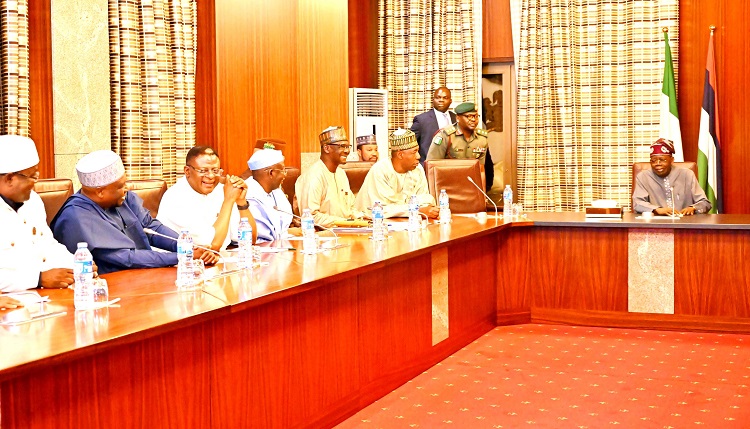
Tinubu stated this on Thursday night in a message posted on his verified X handle, @officialABAT, following a meeting with state governors at the State House, Abuja.
According to him, the Federal Government and the states have agreed to establish a joint committee to immediately work out measures to reduce transportation costs across the country.
He said vehicles powered by CNG spend between 60 and 80 per cent less on fuel than petrol-powered vehicles, making it necessary for the savings to be reflected in the fares paid by commuters.
“From October 1, our goal is that Nigerians begin to partake in those savings through lower transport fares.
“We have agreed that cheaper fuel should result in cheaper fares!” Tinubu said.
The President expressed satisfaction with the outcome of his meeting with the governors, noting that they had, on their own initiative, resolved to take immediate steps to reduce transportation costs in their respective states.
“I am pleased with my discussion with the Governors’ Forum this afternoon.
“The governors have, on their own initiative, resolved to take immediate measures to bring down the cost of transportation in their states, with a strong focus on leveraging the cost benefits of CNG and electric vehicles,” he said.
Tinubu noted that the Federal Government had already committed substantial resources to the transition to cheaper and cleaner transportation energy through the Presidential CNG Initiative.
He said more than 120,000 vehicles had so far been converted to CNG nationwide, while more than 100,000 additional conversion kits were being processed for deployment.
“The Federal Government is already investing significantly in this energy transition.
“Through the Presidential CNG Initiative, over 120,000 vehicles have been converted nationwide, with more than 100,000 additional conversion kits in the works.
“At the same time, we continue to expand conversion centres and refuelling infrastructure nationwide,” the President said.
He added that the Federal Government, through the Midstream and Downstream Gas Infrastructure Fund, was financing more than 100 gas projects across the country, comprising 15 CNG mother stations and 86 daughter stations.
Tinubu recalled that in May, he inaugurated four of the projects in Lagos, Abuja and Owerri, including a 15-station refuelling network in Lagos and a facility in Abuja with the capacity to serve 1,000 cars and tricycles as well as 50 trucks and buses daily.
The President also disclosed that he had directed the rollout of another 500 CNG refuelling stations nationwide, in addition to the 500 stations earlier ordered for deployment this year.
The fresh directive, he said, would bring the planned nationwide CNG refuelling network to 1,000 stations.
“I have also directed the additional rollout of another 500 CNG refuelling stations nationwide in addition to the 500 stations ordered earlier in the year by the Fund, bringing the programme to 1,000 stations across the country,” Tinubu said.
The President stressed that state governments have a crucial role to play in reducing transport costs because intra-state transportation is the segment where Nigerians most directly experience the burden of high fares.
“Intra-state transport is where Nigerians feel the cost most directly, and it is where the states hold the levers.
“I am encouraged that our Governors are moving to bring these benefits closer to the people they serve,” he said.
Tinubu said the joint Federal Government and state committee would commence implementation of the agreed measures immediately as both tiers of government work towards ensuring that lower CNG operating costs translate into cheaper fares for commuters.
He stressed that easing transportation costs required collaboration among the different tiers of government.
“Each tier of government must keep doing its part and work together for the benefit of every Nigerian.
“Nigeria First,” the President said.
Governors Fault Claims of Mismanagement of Subsidy Removal Proceeds
Before their meeting with the President on Thursday, the governors had met under the aegis of the Nigeria Governors’ Forum (NGF) on Wednesday night, where they pledged to collaborate with the private sector to drive down transportation costs by taking advantage of CNG.
The governors also countered claims that the sub-national governments had failed to properly account for their share of the proceeds from the removal of fuel subsidy.
On May 29, 2023, President Tinubu, in his inaugural address, declared that “fuel subsidy is gone.”
According to the Federal Ministry of Finance scorecard presented by the Minister of Finance and Coordinating Minister of the Economy, Taiwo Oyedele, proceeds from the removal of fuel subsidy between June 2023 and December 2025 amounted to N15.8 trillion.
The Federal Government received N5.4 trillion, state governments got N6.5 trillion, while local governments received N3.9 trillion.
Bayelsa State Governor Douye Diri, who spoke with reporters on behalf of the forum, dismissed allegations of fund misuse, insisting that the states had properly accounted for their expenditure.
“That cannot be true. That cannot be true. But we will leave that debate for another day,” Diri said.
Diri, who read the communiqué signed by the NGF Chairman and Governor of Kwara State, AbdulRahman AbdulRazaq, said the governors agreed to develop modalities for improving the financing and adoption of CNG-powered vehicles as part of measures to address rising transportation and food costs.
He said the plan included working with the private sector to increase investment in and deployment of CNG, with the ultimate aim of reducing the prices of goods and services.
The Bayelsa governor said the NGF took the decision after receiving a presentation on the proposed National Affordable CNG Transit Programme (NACTP), a state-led initiative designed to support the transition to CNG-powered transportation.
He said the proposal envisaged state support for CNG vehicle conversions, fleets and enabling infrastructure, alongside fare commitments from participating operators, with an indicative target of reducing passenger fares.
Diri noted the potential of the initiative to ease transportation costs, adding that the forum agreed to further consider its financing and implementation framework.
He said the initiative could eventually make the debate over the suitability or otherwise of fuel subsidy removal less significant by addressing one of its major effects on Nigerians.
According to him, rising transportation costs have contributed significantly to increases in the prices of goods, particularly food.
“Now that the forum is going in league with the private sector to see how we can bring in CNG, it will actually reduce the cost of transportation. You know that gas is cheaper than petrol and others.
“The initiative will have multiplier effect on every other sector and that is because of the removal of fuel subsidy and the impact is expected to be on our people, that is, the very common man that we all talk about,” he said.
On why the governors were focusing on transportation rather than directly targeting food prices, Diri explained that transportation was central to the cost of several other goods and services.
He said food sellers often attributed increases in the prices of commodities to the cost of transporting them from one location to another.
“A seller will tell you that he/she moved from point A to point B, and the transport cost is XY, and so, the cost of my yam; the cost of my gari, and others have increased. So, as I said earlier, our focus will have a multiplier effect,” Diri said.
During the NGF meeting, the governors also listened to a presentation by the Minister of Industry, Trade and Investment, Dr Jumoke Oduwole, on opportunities for state participation in CANEX Weekend 2026 and the Intra-African Trade Fair (IATF) 2027, scheduled to take place in Lagos.
The governors acknowledged the potential of the platforms to showcase investment-ready projects, promote local exports and tourism, and connect state-based micro, small and medium enterprises with African and global investors and buyers.
They assured the minister of their support towards achieving the objectives of the programmes.