


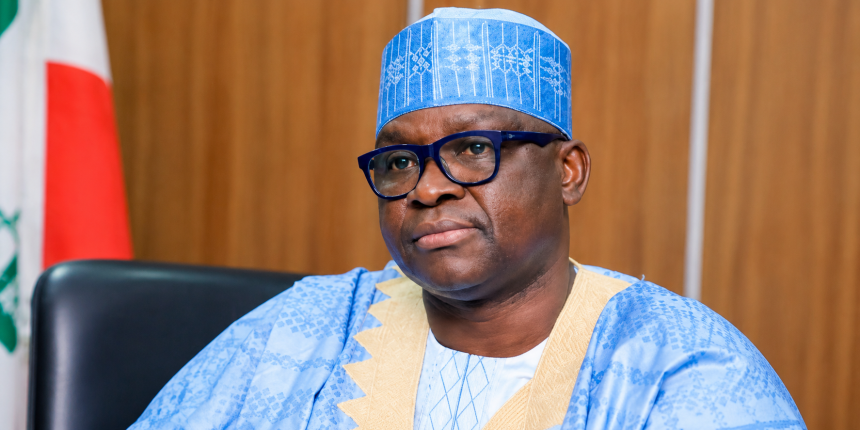
Osun Election: I Was in Osogbo Throughout Poll to Understand Voters’ Mood — Fayose
Former Ekiti State Governor, Ayo Fayose, has explained why he stayed in Osogbo throughout the August 15 Osun State governorship election, saying his presence was aimed at understanding the mood of voters and assessing the likely outcome of the poll.
Fayose disclosed this during an interview with TVC News, where he reviewed the election, the factors that influenced the result and the need for reconciliation among political stakeholders following Governor Ademola Adeleke’s victory.
According to the former governor, he deliberately remained in Osogbo and visited several communities, markets and other parts of the state to interact directly with residents and gain firsthand knowledge of their views ahead of the election.
He said, “Well, let me say I was in Osogbo throughout the election. I was in Osogbo because, one, you gain more experience when you are part of a system.”
Fayose explained that his interactions with voters gave him an indication of how closely contested the election would be.
“I was in Osogbo firstly to have information about how that election was going to go with the ordinary folks. I was in a number of market communities. I was in Ilesa. I was in a couple of communities, and I listened to them. So I knew, very clearly, that the outcome ordinarily may not be far from what it is,” he said.
Asked whether he had predicted that Adeleke would win, Fayose said the contest was too close to make a definite prediction, noting that either of the major contenders could have emerged victorious.
“Well, the outcome may not be far from what it is. When you have an election that is 52, 48, it could go either way,” he said.
He explained that a wider gap between the contenders would have made the outcome easier to predict, adding that the closeness of the Osun contest made it difficult to confidently forecast the winner before the votes were counted.
Fayose, however, condemned the violence, desperation and killings that reportedly characterised parts of the election, describing them as unnecessary.
“But what greeted the election towards the end was unfortunate violence, desperation, and killings that were mostly unnecessary,” he said.
He maintained that, based on his observations and interactions with residents, the election could have gone either way.
“So let me say to you, the election, ordinarily because of the closeness, in my perception, could go either way,” Fayose added.
The former governor also urged political actors and observers to look beyond the winner and loser and examine the voting patterns and dynamics that shaped the election.
He noted that Adeleke’s eventual victory was significantly influenced by his strong showing in Ede, the home base of the Adeleke family.
“That election was won by 66,000 votes. Forty-six of that 66,000 votes came from Ede, which is the stronghold of the Adelekes,” Fayose said.
According to him, the result from Ede was not unexpected, given the longstanding support enjoyed by the Adeleke family in the area.
“Everybody, all permutations pointed to, would not be a surprise when you get such figures from Ede. But I personally didn’t look out for 46,000 out of 66,000. It’s all been a known fact that Ede is the base of the Adelekes,” he said.
Fayose further explained how votes from other parts of the state contributed to Adeleke’s overall margin, stressing that the result reflected a combination of performances across several local government areas.
He described the election as keenly contested and congratulated the Adeleke family on the victory, while urging the governor to be magnanimous in victory.
“So let me say to you, it was a keenly contested election, which ordinarily, for Ede, would have gone either way,” he said.
“Let us commend the Adelekes for winning and remind them they need to be magnanimous in victory.”
Fayose also called for comprehensive reconciliation among political stakeholders in the state, stressing that the process should not be limited to the Accord Party but should involve all groups and individuals who participated in the election.
“Be magnanimous in victory. The language now must be right. Reconciliation must be total. Not with Accord alone, but with all other stakeholders because all of you are from Osun State,” he said.
The former governor also addressed claims that the Federal Government intended to influence the outcome of the election, saying that if the government genuinely wanted to take over an election, it would be difficult for anyone to stop it.
“The only thing I hear towards the election was the Federal Government would take it by force, the Federal Government has come to do this. I want to say to you, if the Federal Government wants to take an election, they will take it,” Fayose said.
He recalled his observations of past elections, arguing that the ability of the Federal Government to influence an election would depend largely on its determination to do so.
Fayose’s comments came after the August 15 Osun governorship election, in which incumbent Governor Ademola Adeleke secured another term in office.
The discussion also touched on comments by the Minister of the Federal Capital Territory, Nyesom Wike, who had suggested that the Accord Party’s performance in the election was possible because President Bola Tinubu allowed the poll to be free and fair.
Fayose agreed with Wike’s assessment, responding, “That, that exactly…” before the interview moved on to other issues.