


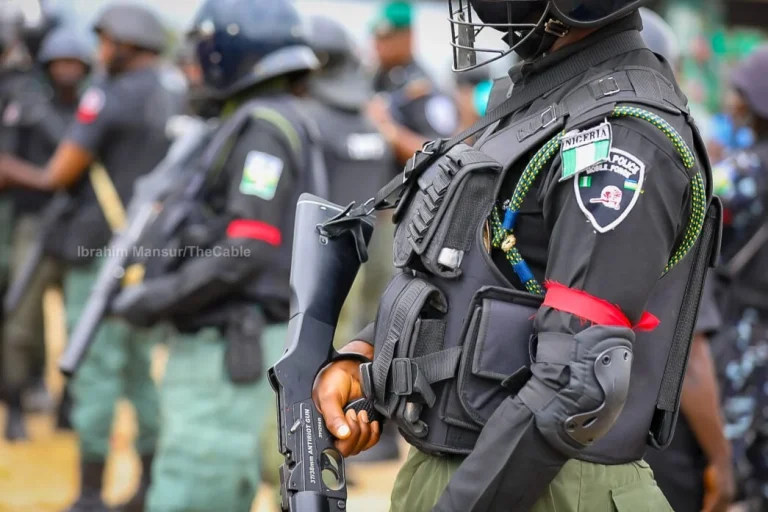
31 States Spend N252bn on Security in Six Months Amid Rising Insecurity
No fewer than 31 state governments spent an estimated N252.26bn on security-related activities in the first six months of 2026, as states intensified efforts to combat criminality, kidnapping, banditry and other security threats.
An analysis of fiscal performance data from the first and second quarters of 2026, obtained from Open Nigerian States, a BudgIT-backed platform that provides access to government budget data, showed that Kogi recorded the highest expenditure at N34.67bn, representing 13.74 per cent of the total captured.
Plateau followed with N23.69bn, or 9.39 per cent, while Bauchi spent N22.35bn, accounting for 8.86 per cent. The three states collectively accounted for about N80.70bn, representing 32 per cent of the total security-related expenditure recorded.
Other states that recorded security-related spending included Abia, Adamawa, Anambra, Bayelsa, Benue, Borno, Cross River, Delta, Ebonyi, Ekiti, Enugu, Gombe, Imo, Jigawa, Kaduna, Kano, Katsina, Kebbi, Kwara, Lagos, Nasarawa, Niger, Ogun, Ondo, Oyo, Sokoto, Taraba and Zamfara.
The expenditure covered areas including security equipment, homeland security personnel, security votes and operations, ministries of security and special advisers, as well as security trust funds.
The latest figures indicate a sharp increase in state-level security spending, with the combined expenditure rising from N75.84bn in 2025 to N252.26bn in 2026. However, the year-on-year comparison is based on 22 states for which 2025 figures were available, meaning the two datasets do not constitute a like-for-like comparison of all 36 states.
By category, states spent N37.08bn on security equipment and N26.89bn on homeland security personnel. Security votes and related homeland security expenditure stood at N135.61bn, while spending under ministries of security and special advisers amounted to N42.15bn.
Security trust fund expenditure also rose to N10.53bn. The spending occurred against the backdrop of persistent insecurity across the country, including killings, kidnapping, banditry, terrorism and communal violence.
The National Human Rights Commission reported that its Human Rights Observatory documented 651 kidnapping incidents and 492 killings between January and March 2026, with the North-Central, North-West and North-East regions among the worst affected.
The situation remained severe in the second quarter, with a report by SARI Global showing that 792 people were killed in 882 security incidents across the 36 states and the Federal Capital Territory in June alone.
Meanwhile, official mid-year operational figures indicated that military and other security agencies conducted about 14,000 operations during the first half of the year, killing 1,597 terrorists and insurgents and rescuing 1,516 kidnapped victims.
Despite the substantial expenditure, the figures have continued to raise questions about the effectiveness, transparency and coordination of security spending at both the state and federal levels.
Kogi’s N34.67bn was the highest expenditure among the states listed, exceeding Plateau’s figure by N10.98bn and Bauchi’s by N12.31bn. Bayelsa ranked fourth with N17.49bn, followed by Ekiti with N14.83bn and Anambra with N13.40bn.
Sokoto recorded N11.27bn, while Ondo and Kaduna spent N10.54bn and N10.37bn respectively. Kebbi recorded N10.14bn, Adamawa N9.95bn, Zamfara N9.07bn and Borno N8.29bn. Kano and Katsina spent N8.26bn and N7.21bn respectively.
Niger spent N5.36bn, Nasarawa N5.18bn, Ebonyi N4.72bn, Kwara N4.69bn and Delta N4.63bn. Oyo recorded N3.82bn, followed by Enugu with N3.46bn and Cross River with N2.43bn.
Ogun spent N1.73bn, Imo N1.52bn and Taraba N1.38bn, while Abia recorded N766.72m. Lagos spent N615.12m and Jigawa N395.33m. Gombe recorded N48.02m, while Benue had only N1.58m across the categories captured in the data.
Akwa Ibom, Osun, Rivers and Yobe had no expenditure recorded in the listed categories, while Edo was also listed without figures. No separate entry for the Federal Capital Territory was contained in the supplied data.
The figures further showed significant changes in security spending among states with available 2025 data. Anambra recorded the largest percentage increase, rising from N22.10m to N13.40bn, while Plateau increased from N12.23bn to N23.69bn.
Sokoto’s expenditure rose from N2.04bn to N11.27bn, while Bayelsa increased from N9.14bn to N17.49bn. Zamfara also recorded a substantial rise, moving from N785.90m in 2025 to N9.07bn in 2026.
However, not all states increased their spending. Oyo’s expenditure fell from N6.76bn in 2025 to N3.82bn in 2026, representing a decline of about N2.94bn, or 43.5 per cent. Taraba and Borno also recorded declines, while Ebonyi remained broadly unchanged.
Overall, the figures show a significant expansion of state-level security financing, particularly in equipment procurement, personnel and security operations. Spending was also heavily concentrated among a relatively small number of states.
The top five spenders — Kogi, Plateau, Bauchi, Bayelsa and Ekiti — accounted for about N112.15bn, representing 44.8 per cent of the total captured, while the top 10 states accounted for approximately N157.65bn, or 66.9 per cent.
The spending pattern, however, does not necessarily correspond directly with the intensity of insecurity in individual states. Zamfara, Borno, Katsina, Kaduna, Sokoto and Kebbi, which have remained major theatres of banditry and insurgency, collectively recorded about N56.04bn, representing roughly 22.2 per cent of the total.
Kogi alone, meanwhile, recorded more than N34.67bn, exceeding the combined expenditure of several states confronting serious security challenges.
The development has prompted calls for greater accountability and more strategic deployment of security funds.
Retired Brigadier General Bashir Adewinbi commended the authorities for increasing dedicated funding to address security challenges but urged Nigerians to wait for the implementation before passing judgment on the initiative.
He said the increased funding could help governments acquire the technology and resources required to tackle terrorism and other security threats more effectively, while stressing that the outcome would ultimately depend on how the funds were deployed.
A former Assistant Inspector-General of Police, Wilson Inalegwu, advocated result-based budgeting, arguing that governors should not simply make large lump-sum allocations to security without clear plans for reducing crime.
According to him, Commissioners of Police should prepare annual policing plans identifying the security challenges in their respective states, the resources required and measurable targets for reducing crime.
He said such plans should take into account kidnapping, banditry, farmers-herders clashes, insurgency, separatist agitations, cultism and election-related security threats, particularly ahead of the 2027 general elections.
Inalegwu also called for periodic reviews involving governors, security advisers and Commissioners of Police to determine whether allocated funds were producing measurable improvements in crime statistics.
He further urged governors to strengthen community policing structures, noting that the amended Police Act 2020 provides for Community Policing Committees at various levels of the police structure.
He stressed that technology should be deployed based on identified security needs rather than purchased merely to demonstrate government spending, arguing that a comprehensive policing plan would determine whether a state required patrol vehicles, surveillance cameras, drones or other equipment.
Also commenting, retired Brigadier General George Emdin said the spending should not be attributed solely to the fight against banditry and kidnapping, noting that state governments had historically maintained security votes.
He added that insecurity in Nigeria was multidimensional and required different strategies to address the various threats confronting the country.
CSOs Demand Accountability
The Executive Chairman of the Centre for Anti-Corruption and Open Leadership, Debo Adeniran, said Nigerians had the right to demand accountability for funds allocated to security.
He argued that the effectiveness of security spending should ultimately be measured by its impact on the lives and property of citizens, while questioning whether funds allocated to security were reaching personnel and agencies that needed them.
“We have the right to ask for accountability. Is the spending going to the right quarters? Are security personnel being well paid?” Adeniran said.
Similarly, the Executive Director of the Civil Society Legislative Advocacy Centre, Auwal Musa Rafsanjani, questioned the whereabouts and utilisation of the funds reportedly spent on security.
Rafsanjani said Nigerians should be able to see corresponding improvements in security if the money had genuinely been spent as reported. He also raised concerns about the welfare and operational capacity of security personnel, many of whom, he noted, continued to complain about inadequate welfare and insufficient equipment.
He further pointed out that the reported N252bn did not include security votes controlled by state governors and local governments, suggesting that the overall amount spent on security could be substantially higher.
Rafsanjani warned against the alleged use of security expenditure as a channel for diverting public funds, stressing that the lives and property of Nigerians should not be used for personal enrichment.
He also called on the Auditor-General for the Federation to provide a detailed breakdown of security-related expenditure, including projects, procurements and other items for which the funds were spent.
He criticised the National Assembly for failing to adequately exercise its oversight responsibilities over security spending, saying, “Unfortunately, the National Assembly that should be doing oversight have decided to donate their powers and responsibilities away.”
Source: The Punch