


Nigeria Urges ECOWAS to Drag South Africa Before AU Over Xenophobic Attacks
• Condemns attacks on Nigerians, other Africans
• Tinubu warns against constitutional amendments to extend tenure
Nigeria has called on the Economic Community of West African States (ECOWAS) to take the issue of recurring xenophobic attacks in South Africa before the African Union (AU), insisting that the continent must send a strong message that violence against fellow Africans will not be tolerated.
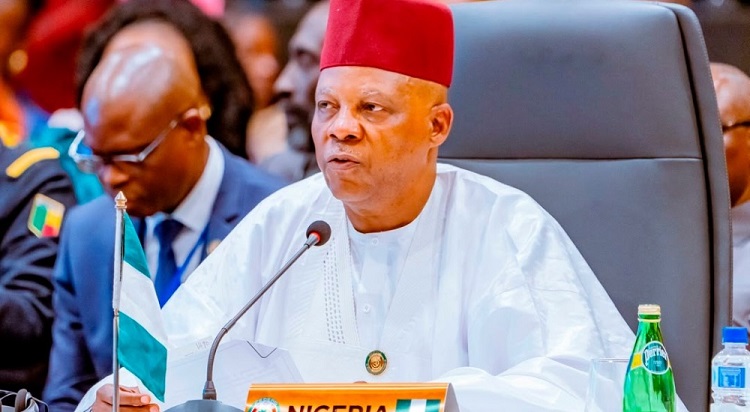
The call was made by President Bola Ahmed Tinubu at the 69th Ordinary Session of the ECOWAS Authority of Heads of State and Government held in Lungi, Sierra Leone, where he was represented by Vice President Kashim Shettima. The President condemned the recent wave of Afrophobic attacks targeting Nigerians and other African nationals in South Africa, describing the development as unacceptable.
Tinubu urged ECOWAS leaders to present the matter at the next meeting of the African Union Authority to ensure a united continental response against xenophobia.
“Nigeria condemns in the strongest terms the recent Afrophobic attacks on its citizens and other fellow Africans in the Republic of South Africa. As already suggested by the President of Ghana, ECOWAS should present this matter before the next meeting of the Authority of the African Union to send a clear message that this type of behaviour is unacceptable,” he said.
The President reminded South Africa that many African countries, particularly Nigeria, made enormous sacrifices during the anti-apartheid struggle that eventually secured the country’s freedom.
“South Africa should be reminded that the freedom the country currently enjoys is due to the liberation efforts of African countries such as Nigeria. The Nigerian Government has evacuated 1,490 of its citizens in seven batches and remains prepared to continue diplomatic engagement on this matter,” Tinubu added.
Nigeria remains one of the countries most affected by repeated xenophobic attacks in South Africa, with many of its citizens reportedly killed, assaulted, displaced and stripped of their means of livelihood after businesses owned by foreigners were looted and destroyed. Citizens of Ghana, Zimbabwe, Malawi, Lesotho and Botswana have also been victims of similar attacks.
The latest position by Nigeria expands earlier comments by the Minister of Foreign Affairs, Ambassador Bianca Odumegwu-Ojukwu, who hinted that the Federal Government could adopt retaliatory diplomatic measures against South Africa. The National Assembly has also condemned the attacks and is expected to make recommendations, while human rights lawyer Femi Falana (SAN) has urged the Federal Government to institute legal action against South Africa before the African Court.
Beyond the xenophobia issue, Tinubu reaffirmed Nigeria’s commitment to the newly adopted ECOWAS Compact for the Future of Regional Integration, describing it as a landmark framework for deepening regional cooperation, economic integration, democratic governance and sustainable development across West Africa.
He said Nigeria remained committed to implementing the Compact, noting that it aligns with the aspirations of ECOWAS Vision 2050 while extending the bloc’s strategic outlook to 2075.
“As the largest economy and one of the founding members of ECOWAS, Nigeria remains steadfast in its historic responsibility to promote regional unity, peace, economic integration and democratic governance,” the President said.
Tinubu also pledged Nigeria’s support for initiatives aimed at removing trade barriers, improving cross-border infrastructure and promoting the free movement of persons, goods and services to stimulate investment and economic growth across the sub-region.
On democratic governance, the President warned that insecurity, poor governance and constitutional manipulation remain major threats to peace and stability in West Africa. He cautioned leaders against altering constitutional term limits to prolong their stay in office.
“Beyond military adventurism, the most effective tool against unconstitutional changes of government and mass protests capable of undermining public order is to enthrone good governance that delivers tangible benefits to our citizens. We must also avoid the temptation to tamper with constitutional term limits or exploit constitutional processes,” he said.
Tinubu further reaffirmed Nigeria’s commitment to the establishment of the proposed ECOWAS Counter-Terrorism Force and the strengthening of the ECOWAS Standby Force to enhance intelligence sharing, joint security operations and regional responses to terrorism and violent extremism.
He also pledged Nigeria’s continued support for gender equality, youth empowerment, education and skills development, while urging sustained dialogue with the Alliance of Sahel States (AES) to preserve the unity and relevance of ECOWAS.
Host President Julius Maada Bio of Sierra Leone described the summit as an opportunity for West African leaders to assess the bloc’s achievements and chart a fresh course for the region, noting that ECOWAS Vision 2050 provides a roadmap for building a peaceful, prosperous and democratically governed West Africa.
President of the ECOWAS Commission, Dr. Omar Alieu Touray, said the Commission had strengthened regional cooperation against terrorism, violent extremism and organised crime while advancing major infrastructure projects, including the African Atlantic Gas Pipeline and the Abidjan-Lagos Corridor Highway Project, aimed at boosting economic integration across the sub-region.