


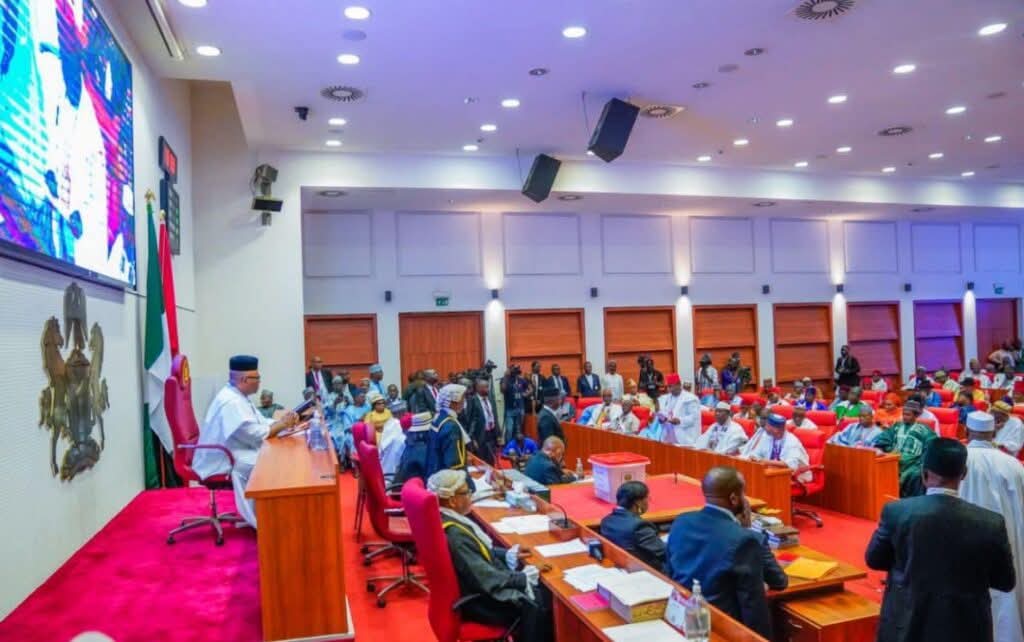
Senate to Consider State Police Bill Tuesday
The Senate is set to consider a constitutional amendment bill seeking the establishment of state police across Nigeria on Tuesday, in a move lawmakers say could significantly strengthen the country’s security architecture.
Senate Leader, Opeyemi Bamidele, disclosed this in a statement issued on Monday through his Directorate of Media and Public Affairs, revealing that the proposed legislation could be transmitted to the 36 State Houses of Assembly for ratification once it is passed by the National Assembly.
Bamidele said there was broad consensus among key stakeholders on the need for state police, noting that the National Assembly had resolved to separate the provision from the broader constitutional amendment process because of its urgency and national importance.
“Our position is very clear on state police. We are standing with Nigerians on this issue. All strata of the federation have made it clear that there cannot be a better time to establish state police than now,” he said.
According to him, President Bola Tinubu and state governors have expressed support for the proposal, making the current legislative week a crucial one for the Senate.
“We came to the conclusion that we are going to pass the constitutional amendment in this respect to make provision for state police. If I can tell you as of today, that will come to fruition this very week because there is no need for any further delay,” Bamidele stated.
The Senate leader revealed that the National Assembly leadership had held a series of consultations over the past week with the Office of the Attorney-General of the Federation, the Chief of Staff to the President, Femi Gbajabiamila, the Inspector-General of Police and other critical stakeholders to fine-tune the framework for the proposed legislation.
He expressed confidence that the bill was now ready for passage.
Bamidele explained that after passage by the National Assembly, the proposal would be transmitted to the state legislatures for ratification in line with constitutional requirements.
“The bill can be on its way to the 36 State Houses of Assembly as soon as possible because we will need the approval of at least two-thirds of the state assemblies before the President can assent to it. The President is also with us on this proposal and I am sure he cannot wait for the bill to come to him for assent,” he said.
The renewed push for state police comes amid growing calls for decentralisation of policing powers as Nigeria grapples with banditry, kidnapping, insurgency, farmer-herder clashes and other security challenges across different regions.
Section 214(1) of the 1999 Constitution currently provides for a single federal police structure known as the Nigeria Police Force, effectively prohibiting the establishment of state or local police formations.
Any amendment to that provision must secure approval by the National Assembly and be ratified by at least 24 of the 36 State Houses of Assembly before it can be signed into law by the President.
Supporters of state police argue that state governments are better positioned to recruit and deploy officers familiar with local terrain, languages and community dynamics, thereby improving intelligence gathering and response to security threats.
Critics, however, have expressed concerns that state-controlled police forces could be misused by governors to intimidate political opponents and suppress dissent if adequate safeguards are not put in place.
Earlier, Chief of Staff to the President, Femi Gbajabiamila, disclosed that President Tinubu would soon receive a comprehensive report on the proposed state police framework as consultations on its constitutional and operational structure near completion.
Tinubu has repeatedly expressed support for state police as part of his administration’s broader security reform agenda, while the National Assembly continues efforts to develop a framework that balances operational effectiveness with accountability and oversight.
If passed and ratified, the amendment would represent one of the most significant security reforms since Nigeria’s return to democratic rule in 1999.
Source: Punch