


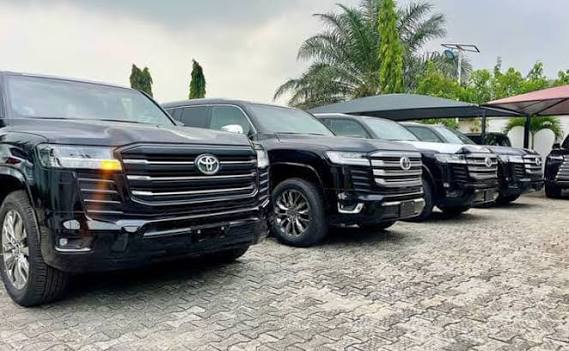
Court Voids National Assembly’s #110 Billion Spending on SUVs
A Federal High Court sitting in Lagos has declared unlawful the National Assembly’s expenditure of N110 billion on Sport Utility Vehicles (SUVs) and support allowances for lawmakers, ruling that the spending violated procurement laws and breached public trust.
In a judgment delivered on May 6, Justice Yellim Bogoro nullified the N40 billion spent on the procurement of 465 vehicles for federal lawmakers and the N70 billion disbursed as support allowances to members elected in 2023. The court held that the expenditures failed to comply with due process requirements and statutory procurement standards.
The suit, marked FHC/L/CS/1606/2023, was instituted by the Socio-Economic Rights and Accountability Project (SERAP) against the National Assembly. The court also directed Senate President Godswill Akpabio and Speaker of the House of Representatives Tajudeen Abbas to ensure that all future procurement and expenditure by the legislature strictly adhere to the principles of transparency, accountability, due process and value for money.
Justice Bogoro described the spending as arbitrary and disproportionate, noting that the beneficiaries were the same officials who approved the expenditure. According to him, such an arrangement constituted self-dealing and a clear conflict of interest. He further observed that allocating N110 billion for lawmakers’ benefit amid widespread economic hardship reflected a failure to prioritise the interests of Nigerians.
The judge rejected the defendants’ argument that legislative autonomy shielded the spending from judicial scrutiny, stressing that the doctrine of separation of powers could not be used to justify illegality. He held that public officers have a fiduciary responsibility to act in good faith and within constitutional limits, adding that public office must not be used for personal enrichment.
The court further ruled that the National Assembly failed to provide credible evidence of compliance with procurement procedures, including competitive bidding and value-for-money assessments. Justice Bogoro noted that the defendants did not specifically rebut the allegations brought against them and were therefore deemed to have admitted them.
He subsequently held that the expenditure violated Section 57(4) of the Public Procurement Act 2007, which mandates transparency, accountability and due process in public procurement. The court also found the spending inconsistent with provisions of the Code of Conduct for Public Officers, which prohibit public officials from placing themselves in positions of conflict of interest or using their offices for personal gain.
The judgment follows the House of Representatives’ confirmation in October 2023 that it had commenced a phased process for procuring and distributing operational vehicles to lawmakers.