


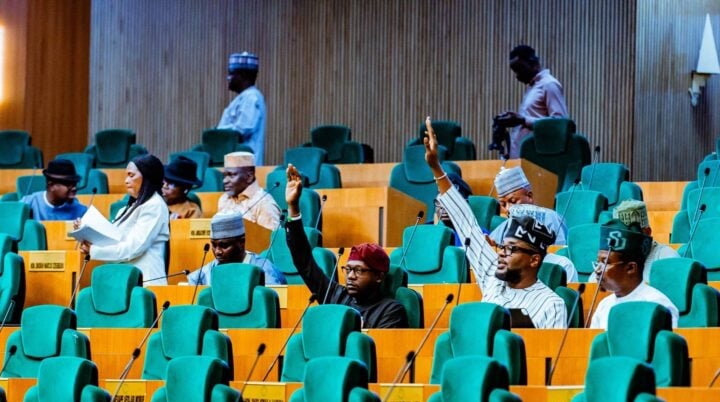
House of Representatives considers bill for 50-year economic plan for Nigeria (2027 – 2076)
A bill proposing the establishment of a 50-year national economic development plan for Nigeria has passed second reading in the House of Representatives.
The bill, sponsored by Amobi Ogah, a lawmaker representing Abia State, scaled through during Wednesday’s plenary session.
Leading the debate, Ogah described the proposed framework spanning 2026 to 2076 as a bold and transformative effort aimed at addressing Nigeria’s longstanding development challenges and policy inconsistencies.
He said the initiative seeks to create a legally binding long-term economic blueprint that would guide national development across successive administrations.
According to him, institutionalising continuity, coordination, and accountability would help ensure sustainable economic growth and improve Nigeria’s global competitiveness.
Ogah noted that Nigeria’s development trajectory has been shaped by a series of ambitious but poorly implemented plans, including Vision 2010, Vision 2020, and the Economic Recovery and Growth Plan (ERGP).
“From Vision 2010 to Vision 2020 and the ERGP, the country has repeatedly demonstrated its capacity to plan, but not necessarily to sustain those plans,” he said.
He attributed the failures of past initiatives to frequent policy shifts, weak institutional frameworks, and the absence of legal backing, which have often resulted in abandoned projects, policy reversals, and inefficient use of public resources.
“These structural deficiencies have hindered long-term economic transformation, leaving the country vulnerable to external shocks, particularly fluctuations in global oil prices,” he added.
Ogah explained that the proposed 50-year plan would provide a stable and predictable economic direction, ensure continuity across administrations, promote economic diversification, and strengthen coordination in national planning.
He also said it would introduce legal backing for implementation, monitoring, and evaluation, while embedding compliance mechanisms across government institutions and enhancing investor confidence through policy stability.
Supporting the bill, the House Majority Leader, Julius Ihonvbere, stressed the need for a disciplined planning framework that transcends political transitions.
“This way, any party in power will not deviate from it,” he said.
The bill was unanimously adopted at second reading after a voice vote conducted by Deputy Speaker Benjamin Kalu, who presided over the plenary.