


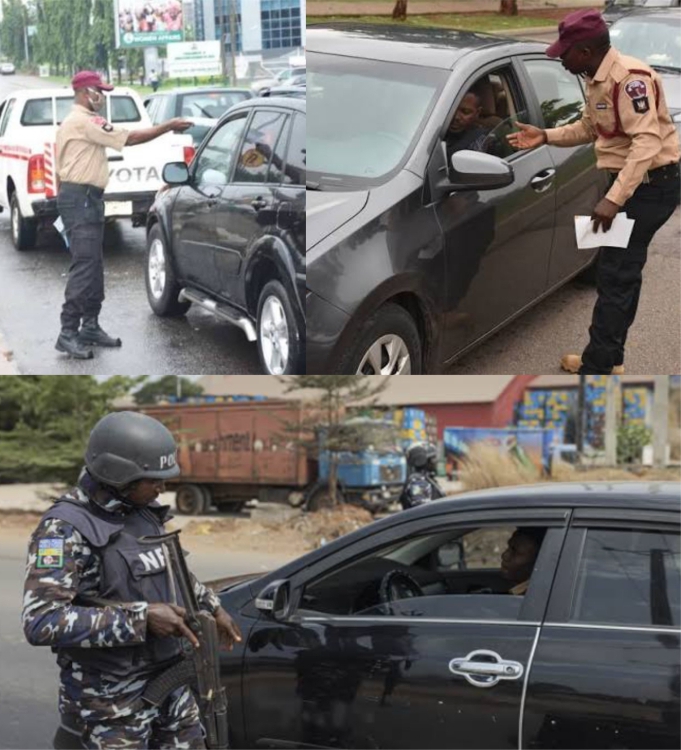
Court restrains Police, FRSC from imposing fines on motorists over third-party insurance
The Federal High Court in Abuja has restrained the Nigeria Police Force and the Federal Road Safety Corps (FRSC) from imposing fines on motorists for failure to present third-party motor vehicle insurance without a court order.
The judgment followed a suit marked FHC/ABJ/CS/291/2025 filed by activist-lawyer Deji Adeyanju against the Inspector-General of Police, the Attorney-General of the Federation, and the FRSC.
Delivering judgment on Friday, Justice Hauwa Yilwa held that while both the police and the FRSC are empowered to enforce compliance with third-party insurance requirements, neither agency has the legal authority to impose fines on alleged offenders.
The court was asked to interpret provisions of the Motor Vehicles (Third Party Insurance) Act, 1950, the Insurance Act, 2003, and the FRSC Establishment Act, 2007, particularly on whether enforcement powers include the imposition of fines during roadside checks and stop-and-search operations.
Adeyanju also asked the court to determine whether such enforcement by security agencies without judicial backing violated constitutional rights, and whether the FRSC holds exclusive authority over third-party insurance enforcement.
He further sought an order permanently restraining the police from enforcing third-party insurance compliance and from issuing fines without court approval, as well as a directive holding the Attorney-General responsible for clarifying the legal limits of police powers.
In its ruling, the court drew a clear distinction between enforcement and punishment. It affirmed that both the police and the FRSC may conduct checks to ensure compliance with motor insurance laws but cannot impose fines on motorists.
Counsel to the applicant, Marvin Omorogbe, said the court held that while enforcement is lawful, the imposition of fines by either agency is not supported by law.
He added that the court also restrained the police, FRSC, and their officers from levying fines on motorists during enforcement exercises.
Reacting to the judgment, Adeyanju described it as a major victory, saying the core objective of the case had been achieved.
He said the ruling would help curb alleged extortion by enforcement agencies and strengthen motorists’ confidence in asserting their rights.
Although the court did not fully strip the agencies of enforcement powers, Adeyanju noted that it made a significant pronouncement on the limits of those powers.
He urged Nigerians to rely on the judgment to challenge unlawful fines where necessary.
However, counsel to the defendants, Victor Okoye, said the ruling was only partially favourable to the police and confirmed that an appeal is being considered.
Okoye argued that the court lacked jurisdiction to hear the matter, insisting that the originating summons was inappropriate for issues he described as contentious.
He also contended that the suit was improperly constituted, noting that the Inspector-General of Police was sued instead of the Nigeria Police Force as a legal entity.
Despite these objections, he acknowledged that the court affirmed the right of both the police and FRSC to stop, search, and verify insurance compliance.
The defendants are expected to decide on further legal steps at the Court of Appeal.