


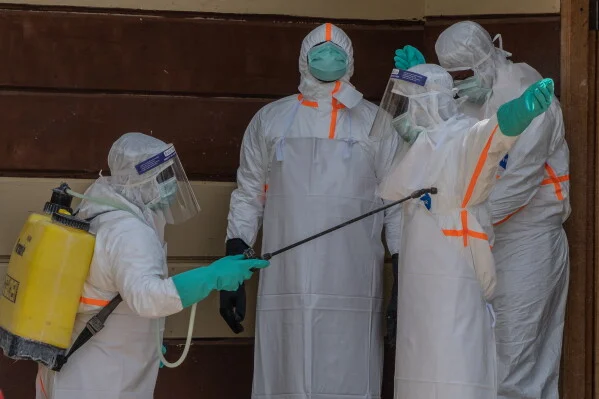
FG Quarantines High-Risk Ebola Contacts, Says Infected Patient Showing Signs Of Recovery
The Federal Government has intensified efforts to contain Nigeria’s confirmed case of Ebola Virus Disease (EVD), placing high-risk contacts in quarantine and strengthening disease surveillance across states and health facilities.
The Coordinating Minister of Health and Social Welfare, Professor Ali Pate, said the government was taking precautionary measures to prevent the virus from spreading into communities, adding that the index patient was showing significant signs of recovery.
Pate, who spoke during a briefing in Abuja, said laboratory results indicated that the patient’s condition had improved considerably, expressing optimism that she could recover fully.
However, he stressed that the government would not take anything for granted despite the absence of evidence of community transmission.
Nigeria currently has one confirmed case, while 46 contacts linked to the patient are being traced and monitored. The government has not publicly disclosed how many of the contacts are classified as high-risk or whether any of them have tested positive.
The Minister of Aviation and Aerospace Development, Festus Keyamo, had directed the Federal Airports Authority of Nigeria (FAAN) to place the 46 contacts on a no-fly list. They comprise 44 people who came into contact with the patient at a hospital after she developed symptoms and two members of her domestic staff.
Keyamo said he had also directed the Nigeria Civil Aviation Authority (NCAA) to notify domestic and international airlines of the restriction, which is intended to prevent the contacts from travelling by air while they are being monitored for possible infection.
He also ordered increased Ebola surveillance at international airports, including temperature checks, travel history monitoring, digital health declarations and closer coordination with public health authorities.
According to Pate, the patient’s travel history suggested that the infection was imported. She reportedly had no symptoms when she arrived in Nigeria but developed them days later.
Contact tracing has covered people at the hospital where she received treatment, her domestic contacts and a private medical facility she visited.
High-risk contacts have been placed in quarantine at a designated facility, while other contacts are being monitored in line with public health guidelines. The Nigeria Centre for Disease Control and Prevention (NCDC) has activated its incident management system in collaboration with the Federal Capital Territory Administration.
“I spoke with the clinicians today, and I understand that the laboratory results show significant improvement. There is a possibility that she will recover fully. However, we cannot take anything for granted,” Pate said.
“We currently have one confirmed case, and our priority is to contain it and prevent transmission into communities or a wider outbreak,” he added.
The government has informed state governments and directed those yet to complete their Ebola response plans to do so urgently. Additional resources have also been mobilised to strengthen the NCDC’s capacity, while the Presidential Task Force on Ebola Preparedness and Emerging Public Health Threats has intensified coordination.
The task force chairman and Chief of Staff to the President, Femi Gbajabiamila, said Nigeria’s surveillance system had enabled the early identification of the case.
Gbajabiamila said the patient had no symptoms when she arrived in Abuja, with symptoms emerging four days later. He attributed the detection to protocols established by the Ministry of Health, the task force and other relevant agencies.
He assured Nigerians that the task force would strengthen existing protocols and ensure stricter enforcement, urging citizens to cooperate with public health authorities.
Africa CDC Seeks Full Disclosure Of Patient’s Travel History
Meanwhile, the Director-General of the Africa Centres for Disease Control and Prevention (Africa CDC), Dr Jean Kaseya, has called for full disclosure of the patient’s travel history to help establish where she contracted the virus.
Speaking on Channels Television’s Morning Brief, Kaseya said the woman was born in Uganda and had travelled there, where she spent some time before her husband joined her. He said the couple returned to Abuja on October 3.
He said African health authorities were working together to determine whether the infection originated in Uganda, the Democratic Republic of Congo or another location.
“What we want is collaboration from this lady. She has to tell us, to disclose to the authorities; I need this information, Nigeria needs this information because we need also to support Uganda,” Kaseya said.
His comments followed differing accounts from Nigerian and Ugandan authorities regarding the patient’s nationality and travel history.
Uganda’s health authorities had said the woman was Nigerian and had travelled to eastern Democratic Republic of Congo for business before passing through Uganda.
Uganda’s Director-General of Health Services, Charles Olaro, maintained that travelling through Uganda did not establish that the infection was contracted there, adding that the source of exposure remained under investigation.
Kaseya also explained that no vaccine was currently available for the Bundibugyo strain responsible for the outbreak, although clinical trials of candidate vaccines, including one manufactured in Egypt, had commenced.
He criticised what he described as inadequate global investment in developing vaccines for diseases predominantly affecting Africa, urging international partners to provide stronger support for vaccine research and development.
Tomori Demands Transparency In Ebola Response
Renowned virologist and Chairman of the West African National Academy of Scientists, Professor Oyewale Tomori, has urged the Federal Government to provide comprehensive information about the confirmed case, warning that gaps in official communication could fuel rumours and undermine public confidence.
“The government must be completely transparent about matters like this. We don’t want to hear information in bits and pieces from different sources,” Tomori said.
He called for clearer information about the patient’s movements, the scope of contact tracing and the handling of diagnostic samples, while acknowledging that some medical details might need to remain confidential.
Tomori recalled Nigeria’s experience during the 2014 Ebola outbreak, when the infection involving Liberian-American Patrick Sawyer took several days to diagnose.
He urged health workers to pay close attention to patients’ travel histories and possible exposure to infectious diseases before dismissing symptoms as malaria or other common illnesses.
He also stressed the need for adequate isolation facilities, trained personnel and medical supplies to manage additional cases should any contacts test positive.
“Suppose two or three of those contacts test positive. What happens next? Do we have the hospitals, isolation facilities and other resources needed to manage additional cases?” he asked.
South-East States Intensify Disease Surveillance
Meanwhile, state governments across the South-East have strengthened disease surveillance and activated precautionary measures, although no Ebola case has been confirmed in the zone.
In Abia State, the Permanent Secretary of the Ministry of Health, Dr Blossom Uma-Kalu, said the government was assessing its preparedness, including the availability of personal protective equipment, thermometers and hand sanitisers.
She said the Infectious Disease Hospital in Aba was nearing completion, while an isolation facility at a specialist hospital in Umuahia was undergoing remodelling.
Uma-Kalu added that the state was considering an additional facility that could be adapted for isolation if necessary. She urged health workers, particularly those in private hospitals and laboratories, to remain vigilant and promptly report suspected cases.
In Enugu State, the Commissioner for Health, Professor George Ugwu, said disease surveillance had been intensified across the state’s 17 local government areas, while the Public Health Emergency Operations Centre had been reactivated.
He said rapid response teams were on standby and urged public and private health facilities to isolate suspected cases promptly and report them to the appropriate authorities.
Ugwu noted that Enugu’s position as a travel and commercial hub, particularly through the Akanu Ibiam International Airport, made increased surveillance necessary.
In Anambra State, the Commissioner for Health, Dr Afam Ben Obidike, announced plans to deploy surveillance officers at strategic locations, including the Chinua Achebe International Airport in Umueri, motor parks, banks and other public places.
He said the state had monitored 40 persons of interest, with 33 completing their monitoring period and being cleared, while seven remained under active follow-up. All seven were reportedly stable.
Obidike said the state’s preparedness plan covered surveillance, rapid response, infection prevention, laboratory coordination and risk communication.
In Ebonyi State, the Commissioner for Health, Dr Moses Ekuma, said precautionary measures had been activated, an equipped isolation centre established and health workers trained in infection prevention and control.
He urged residents to maintain good hygiene, cook bush meat thoroughly and exercise caution during burials where the cause of death was unknown.
FG Urges Calm, Warns Against Misinformation
Pate said the government had strengthened preparedness in federal hospitals and urged state governments to ensure adequate bed capacity, functional isolation facilities and strict infection prevention measures.
He called for closer cooperation between public health authorities and private medical practitioners, stressing that suspected cases must be identified and reported promptly.
The minister advised Nigerians to wash their hands frequently and avoid contact with the blood and other body fluids of suspected or confirmed Ebola patients.
“Ebola is not an airborne disease. It is transmitted through direct contact with infected body fluids,” he said.
He added that the government was monitoring the situation and would rely on scientific evidence in deciding whether to adjust plans for conferences, campaigns and other public gatherings.
The government also warned against spreading unverified claims on social media, urging people identified through contact tracing to comply with quarantine and isolation directives.
Pate expressed confidence in Nigeria’s ability to contain the outbreak, citing the country’s experience in managing the 2014 Ebola outbreak.
He urged Nigerians to remain calm, rely on information from recognised public health authorities and cooperate with measures aimed at preventing further transmission.