


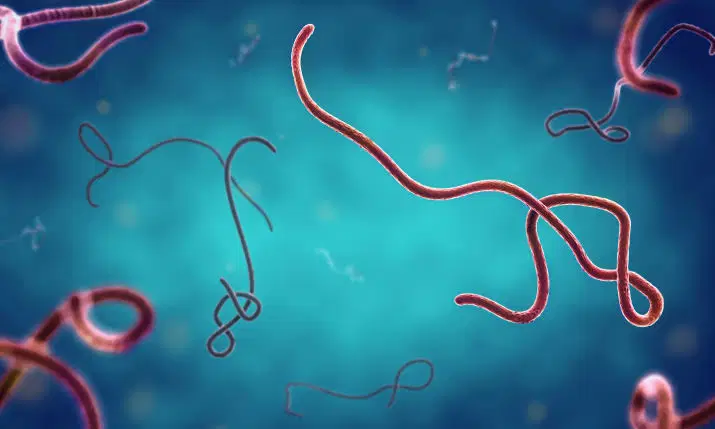
WHO Says No Vaccine, Specific Treatment for Ebola Strain Confirmed in Nigeria
The World Health Organisation (WHO) has confirmed that the Ebola virus detected in Nigeria is the Bundibugyo strain, for which there is currently no approved vaccine or specific treatment, raising concerns over the country’s preparedness and response to the outbreak.
The development comes amid revelations that the index patient arrived at the Nnamdi Azikiwe International Airport, Abuja, aboard an Ethiopian Airlines flight on October 3, 2026, according to an aviation official who spoke on condition of anonymity.
The confirmation has prompted intensified contact tracing and surveillance, with public health authorities identifying 44 close contacts of the patient, including healthcare workers, fellow hospital patients, caregivers and people linked to her travel itinerary.
The Federal Government has placed health institutions and port health surveillance units across the country on high alert as efforts continue to contain the infection and prevent further transmission.
Nigeria Confirms Bundibugyo Strain
The Director of the Public Health Laboratory Service at the Nigeria Centre for Disease Control and Prevention (NCDC), Olajumoke Babatunde, disclosed that laboratory tests confirmed the Bundibugyo strain.
“We did three levels of tests, but all molecular. The strain was Bundibugyo,” Babatunde said.
The WHO also confirmed the strain, which has no approved vaccine or specific treatment.
An official familiar with the case said the patient was a diplomat and had deteriorated into multi-organ failure. The official, however, did not disclose her nationality.
The Coordinating Minister of Health and Social Welfare, Professor Muhammad Ali Pate, had earlier confirmed that the female patient recently returned to Nigeria from Uganda and received treatment at a private hospital in Abuja for several days before the infection was diagnosed.
She has since been transferred to a designated isolation facility for treatment.
In response, the Federal Ministry of Health and Social Welfare, the NCDC and the FCT Health and Environmental Services Secretariat have commenced a multi-agency contact-tracing operation.
Uganda Requests Patient’s Travel and Clinical Records
Meanwhile, the Ugandan government has asked Nigeria to provide detailed travel and clinical records of the patient to establish the circumstances surrounding the infection and determine whether additional contact tracing is necessary.
Uganda’s Director-General of Health Services, Professor Charles Olaro, said the woman’s transit through the East African country did not establish that she contracted the virus there.
In a statement issued in Kampala, the Ugandan Ministry of Health said preliminary information indicated that the woman travelled to the eastern Democratic Republic of the Congo for business and transited through Uganda in early October without showing symptoms.
According to the statement, she reportedly developed symptoms after arriving in Nigeria, while the location where she contracted the infection remains under investigation.
“The government of Nigeria is yet to provide detailed information on the woman’s travel itinerary and clinical history to guide further investigations and any necessary contact tracing,” the statement said.
The ministry also stressed that Uganda had no confirmed active Ebola cases as of the date of its statement.
It added that limited provisions had been maintained to facilitate humanitarian and diplomatic movements.
In August, Uganda was declared Ebola-free by the WHO following an outbreak that recorded 20 cases, most of them involving people who had travelled from the Democratic Republic of the Congo.
Nigeria, Uganda Collaborate to Contain Outbreak
Despite Uganda’s position that it had no active Ebola cases, the Nigerian government said it was collaborating with the country to contain the risk of further transmission.
Pate disclosed this while speaking with journalists after a meeting at the Office of the Chief of Staff to the President, Femi Gbajabiamila.
He said Nigeria was working with Uganda while intensifying contact tracing and other containment measures.
“All I can tell you is that we are collaborating with our sister African nation of Uganda. What is important is that we have found this one case. We are doing contact tracing, and we are putting containment measures to ensure that it doesn’t go into our population,” the minister said.
Pate expressed confidence in Nigeria’s public health institutions, citing the country’s experience in managing the 2014 Ebola outbreak.
“We have done it in 2014, and we have good public health institutions,” he said.
He urged Nigerians to remain vigilant without panicking, advising the public to rely on credible information from public health authorities and avoid spreading unverified reports.
“Nigerians should be reassured. We must be vigilant, but not panic, and people should respect public health information from trusted sources, and not spread misinformation and false rumours,” he added.
The minister said the government would continue to provide updates as more information became available, noting that the NCDC had activated its incident management system.
Senate Seeks Mandatory Screening at Entry Points
Meanwhile, the Senate and the House of Representatives have called on the Federal Government to strengthen Ebola prevention measures, including mandatory health screening for arriving passengers at international airports, seaports and designated land borders.
The Senate urged the Federal Ministry of Health and Social Welfare, the NCDC and Port Health Services to introduce temperature and symptom checks for passengers, with enhanced screening for anyone who had been in or transited an affected area within the preceding 21 days, regardless of nationality or country of departure.
It also called for exit screening for departing passengers during any declared public health emergency.
The Upper Chamber urged the Federal Ministry of Budget and Economic Planning to release emergency funds from service-wide votes to relevant agencies to support efforts to contain the disease.
It further called on the Federal Ministry of Health and Social Welfare, the Federal Airports Authority of Nigeria (FAAN) and the Nigeria Immigration Service (NIS) to equip entry points with trained port health officers, thermal scanners, protective equipment and isolation rooms.
The Senate also urged authorities to ensure that isolation and treatment centres were adequately prepared across the 36 states and the Federal Capital Territory.
The resolutions followed a motion sponsored by Senator Francis Adedayo Faduyile, representing Ondo South Senatorial District.
The Senate called for the repeal and re-enactment of the Quarantine Act, originally enacted in 1926, to establish a modern public health legal framework consistent with the International Health Regulations (2005).
The Act provides the legal framework for measures aimed at preventing the introduction and spread of dangerous infectious diseases in Nigeria.
The Senate also urged Nigerians to maintain appropriate hygiene practices, including making hand sanitisers available at event centres, institutions and public and private facilities.
It mandated the Committee on Legislative Compliance to monitor the implementation of the resolutions.
Reps Demand Immediate Release of Health Funds
In a similar move, the House of Representatives called for the immediate release of outstanding appropriated funds to relevant health agencies to strengthen surveillance, contact tracing, laboratory testing and other emergency response measures.
The resolutions followed the adoption of a motion of urgent public importance sponsored by Amobi Ogah, representing Isuikwuato/Umunneochi Federal Constituency of Abia State.
Moving the motion, Ogah described Ebola Virus Disease as a severe and potentially fatal infection that requires early detection, strict infection prevention and control measures, and coordinated public health intervention.
“It is extremely disturbing that yesterday (Tuesday), October 20, 2026, an Ebola Virus case was confirmed in a woman arriving from Uganda in Abuja who tested positive. Health authorities traced 44 contacts for isolation and further tests,” he said.
The lawmaker warned that delays in identifying suspected cases, conducting laboratory tests, isolating infected persons and tracing their contacts could increase the risk of transmission and put additional pressure on the healthcare system.
Presided over by Deputy Speaker Benjamin Kalu, the House unanimously adopted the motion and urged the Federal Government to mobilise private, state and federal health agencies and place them on high alert.
The lawmakers specifically called on the Federal Ministry of Finance to release all outstanding appropriated funds to relevant health agencies without further delay.
They also urged the Federal Ministry of Health and Social Welfare and the NCDC to assess additional resource requirements in line with prevailing epidemiological evidence and public health guidance.
Atiku Demands Accountability for N10bn Ebola Funds
Former Vice President Atiku Abubakar has challenged President Bola Tinubu to account for the N10 billion reportedly announced for Ebola preparedness, alleging that the confirmed case in Abuja had exposed gaps in disease surveillance and the protection of healthcare workers.
Atiku called on the Federal Government to explain how the emergency funds had been spent and why, according to him, frontline health workers were left without adequate protective equipment.
In a statement issued by Phrank Shaibu, Director of Strategic Communication of the African Democratic Congress (ADC) Presidential Campaign Council, Atiku demanded a public audit of the funds, including details of disbursements, contracts, recipients and items delivered.
“Where is the money? Publish the amount actually disbursed, the dates of payment, every contract awarded, every recipient and every item delivered. A press statement cannot replace an audit,” he said.
Atiku also questioned the timeline of the government’s response, claiming that the patient arrived in Nigeria in early October and sought treatment at a private hospital on October 11, while the Federal Government did not publicly confirm the case until October 20.
He alleged that the delay raised concerns about the monitoring of close contacts and the availability of protective equipment for private healthcare workers who attended to the patient.
“During that critical period, 44 close contacts were left unmonitored, while private health workers faced the case without adequate protective equipment. This is a failure of preparedness with potentially grave consequences,” he said.
The former vice president also warned against using the outbreak as a justification to restrict political campaigns or voter participation.
As health authorities continue their response, the effectiveness of contact tracing, timely information sharing, adequate funding and strict infection prevention measures will be critical to containing the reported case and preventing further transmission.