


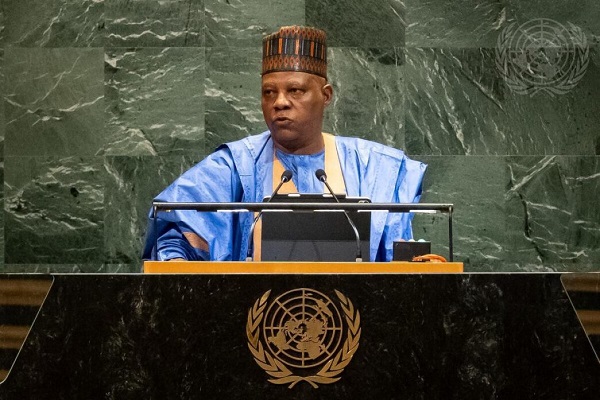
Shettima Says Nigeria Has Crossed Rubicon, Enters Path Of Sustained Growth
Vice President Kashim Shettima has said Nigeria has crossed a critical threshold in its economic reform efforts and is now on the path of sustained growth, urging Nigerians in the diaspora to support the administration of President Bola Ahmed Tinubu and invest in the country.
Shettima made the remarks on Wednesday during an interactive session with Nigerians in the United States at Nigeria House in New York, on the sidelines of the 81st Session of the United Nations General Assembly.
The Vice President cited the rise in Nigeria’s foreign reserves to more than $55 billion, improvements in the foreign exchange market and a 4.45 per cent economic growth recorded in the last quarter as indicators of progress under the administration’s economic reforms.
“Rest assured that beyond the negative stories that you hear and see on social media, Nigeria is open for business. We have crossed the Rubicon, and we are on the path of sustained growth,” Shettima said in a statement issued by his Senior Special Assistant on Media and Communications, Stanley Nkwocha.
He said the government was working to reposition the economy through interventions in education, healthcare, science and technology and agriculture, while creating an environment capable of attracting investment.
Shettima called on Nigerians living abroad to contribute more actively to national development, saying their knowledge, expertise and intellectual capital remained important to Nigeria’s economic transformation.
According to him, the administration intends to leverage the expertise of Nigerians in the diaspora, whom he described as “the greatest resource of the future.”
The Vice President also credited President Tinubu with taking difficult economic decisions early in his administration rather than blaming previous governments for the challenges he inherited.
“When President Tinubu assumed office, he did not resort to trading blames and accusing his predecessor for the state of affairs of our nation. Rather, he took decisions that only a leader of courage and conviction would take,” he said.
Shettima said foreign reserves had increased from $3.9 billion to more than $55 billion, alongside what he described as improvements in the foreign exchange market and economic growth.
He added that stronger foreign reserves and improvements in the foreign exchange market would provide greater protection for remittances and investments made by Nigerians living abroad.
“We are working day and night to reposition the Nigerian nation as investment confidence is returning to Nigeria, and the Dangote Refinery success story is a true manifestation in recent times,” Shettima said.
On education, the Vice President said more than 1.29 million students in tertiary institutions had accessed N125 billion through the Nigerian Education Loan Fund since the programme commenced.
Shettima also acknowledged the security challenges confronting the country, saying the government was deploying available resources to address emerging threats. He noted that security challenges were not peculiar to Nigeria.
He appealed to Nigerians, irrespective of their differences, to work towards building a united and prosperous country, stressing the importance of national cohesion to development.
“Whatever binds us together supersedes whatever divides us as a people,” he said.
Shettima is in New York representing President Tinubu and leading Nigeria’s delegation to the 81st United Nations General Assembly, where he is scheduled to deliver Nigeria’s national statement.
Nigeria’s engagements at the gathering include national interests, reform of global institutions, sustainable development, peace and security, and efforts towards a more equitable international economic order.
Governors Babagana Zulum of Borno, AbdulRahman AbdulRazaq of Kwara, Siminalayi Fubara of Rivers and Dauda Lawal of Zamfara, as well as Senate Leader Opeyemi Bamidele, attended the diaspora engagement.
Also present were the Minister of Foreign Affairs, Ambassador Bianca Odumegwu-Ojukwu; Minister of Science, Innovation and Technology, Dr Kingsley Tochukwu Udeh; Minister of Humanitarian Affairs and Poverty Reduction, Dr Bernard Doro; Minister of Education, Dr Tunji Alausa; Minister of Solid Minerals Development, Chief Dele Alake; and Minister of Women Affairs, Hajiya Imaan Sulaiman-Ibrahim.
Others included the Minister of State for Budget and Economic Planning, Dr Doris Uzoka-Anite; Minister of State for the Federal Capital Territory, Dr Mariya Bunkure; Nigeria’s Permanent Representative to the United Nations, Ambassador Jimoh Ibrahim; Nigeria’s Ambassador to the United States, Ambassador Kayode Are; heads of government agencies and senior officials of Nigeria’s missions in the United States.