


At about 7:30 p.m., the boat was halfway across the Eleyele River when its engine suddenly stopped.
For a few seconds, the only sound was water brushing against the plastic hull. Then the wind began to rise. Passengers shifted uneasily on the wooden planks as I looked towards the opposite bank, close enough to see but suddenly seeming much farther away.
The operator remained calm. He reassured the passengers and attempted to restart the engine, but it refused to come on. We waited for several minutes until another boat appeared and towed us safely to the other side.
We eventually reached our destination, but the experience changed how I viewed the crossing.
Having used the Eleyele water route for years, I had always considered it fast, affordable and familiar. That evening, however, I was confronted with a question that hangs over every ₦100 journey: what happens when the river that transports hundreds of people to work, school and home suddenly becomes dangerous?
By 7:30 a.m. each morning, queues are already forming at the Eleyele River crossing, where workers, traders, schoolchildren and other residents wait to board boats connecting Eleyele with Apete, Awotan and adjoining communities in Ibadan, Oyo State.
For many residents, the crossing has become an essential part of daily life. A journey that could cost considerably more by road takes just a few minutes by water, with passengers paying only ₦100 per trip.
The service connects residents of Idunnu, Oba-Ido, Alakuta, Aderogba, Ogo Oluwa and Idi Mango, among other neighbouring communities. While some use the boats to get to work, others depend on them to reach schools, markets, churches and other destinations across the river.
Sodiq, a commercial motorcyclist familiar with the route, estimates that between 700 and 1,000 passenger journeys are made across the river daily. The steady movement of boats and the growing queues of commuters provide an indication of the extent to which surrounding communities depend on the service.
A cheaper way to get to work
For 22-year-old Medina, who lives in Alakuta and works around Jericho, the river crossing is more than a convenient alternative. It is a means of making her modest monthly income stretch further.
She earns ₦60,000 monthly. Before considering the water route, the cost of commuting to work by road was a major concern. According to her estimate, travelling through Awotan, Apete and Eleyele would require at least three commercial motorcycle rides, costing approximately ₦3,000 daily.
Over 30 days, that would amount to ₦90,000, exceeding her monthly salary.
The boat service has significantly changed the calculation.
Medina says she typically spends less than ₦500 on her daily return journey, although the amount sometimes increases to between ₦600 and ₦700. From the landing point, she walks home.
She also benefits from an informal arrangement among regular passengers who know one another. Sometimes, one person pays another’s fare, with the favour returned on a subsequent day.
For Mr Adeshina, a civil servant working at the Oyo State Secretariat, the river has equally proved invaluable. He has used the crossing for more than four years, having moved into a house less than a kilometre from the river.
He describes the water route as a blessing, explaining that it has substantially reduced his transportation expenses.
His wife, who is a trader, also relies on the crossing to get to her business, while their three children use it to commute to school. For the family, the river is not an occasional shortcut but an essential transportation link that keeps work, business and education within reach.
The fare, which was previously ₦50, increased to ₦100 a few months before this report following rising fuel prices. Despite the increase, the crossing remains considerably cheaper than travelling the entire distance by road.
For residents earning modest incomes, the difference can determine whether a journey is affordable in the first place.
The bridge that changed the journey
The growing importance of the water route is closely connected to the history of Apete Bridge.
On August 26, 2011, torrential rainfall triggered devastating flooding across parts of Ibadan. The Eleyele Reservoir overflowed, while several communities suffered extensive loss of lives and property, with more than 120 deaths reported. Apete Bridge also collapsed during the disaster, disrupting movement between neighbouring communities.
Following the incident, the Oyo State Government established the Ibadan Urban Flood Management Project (IUFMP), with funding from the World Bank and technical support, to strengthen flood-risk management and improve infrastructure.
With the bridge destroyed, residents were forced to rely on alternative road routes. Some travelled through Fanawole, Osajin, Ajibode and the University of Ibadan axis to connect with Sango and Ojoo.
Others used the Lifeforte, Adeosun and Unity Road axis to reach Ologuneru before travelling through Eleyele to access other parts of Ibadan.
Restoring the bridge was not immediate. A temporary wooden crossing was initially constructed to enable pedestrians, particularly students of The Polytechnic, Ibadan, to move across. However, rainfall later washed it away.
Another temporary bridge was subsequently constructed, but it also suffered the same fate.
A more substantial bridge was eventually reconstructed, alongside improvements to the road linking Awotan. By then, however, the river crossing had become an important alternative for residents living close to the water.
Even after road access improved, many commuters continued using the boats because they offered a faster and cheaper means of transportation.
For these residents, the river is not necessarily the only way to get across. It is often the most practical.
The memory of a fatal crossing
Despite its convenience, the water route carries a painful history.
On February 10, 2015, five people drowned after a canoe capsized while returning from Eleyele during a windstorm and heavy rainfall. The victims comprised two couples from two families and a woman who was visiting one of them.
Among them was Nafiu Tunde Yusuf, chairman of the Idunnu Community Landlords’ Association, the community closest to the river crossing.
Yusuf was known for helping residents cross the water. Having learnt to paddle, he sometimes ferried people across when regular canoe operators had stopped operating for the day.
However, on that fateful journey, he was among those who never made it back.
He died alongside his wife, Moriliat Alaba Yusuf. The other couple, Sulaiman Ahmed and his wife, Mulikat Ahmed, also lost their lives, while the fifth victim was Ramotalai Mudashiru, who was visiting the Yusuf family.
A report by Nigerian Tribune at the time quoted Martins Akinyosoye, then security committee chairman of Awotan Community, as saying that eyewitnesses attributed the incident to storm waves.
Yusuf and his wife left behind three children.
Although the tragedy involved a traditional canoe rather than the motorised passenger boats commonly used today, the memory of the incident remains a sobering reminder of how quickly an ordinary journey across the river can turn fatal.
The daily rush and the boats
Today, between 10 and 15 boat operators reportedly provide transportation services along the crossing, with activities becoming particularly busy during weekday mornings.
Ajetunmobi, a commercial motorcyclist familiar with the route, says operations usually begin around 7:30 a.m. and remain busy until about 10 a.m.
Passenger traffic increases again later in the day as workers and other commuters return home. Boat operations can continue until approximately 8:30 p.m.
Weekends are generally quieter because many workers and schoolchildren are not travelling to their usual destinations, although churchgoers still depend on the crossing on Sundays.
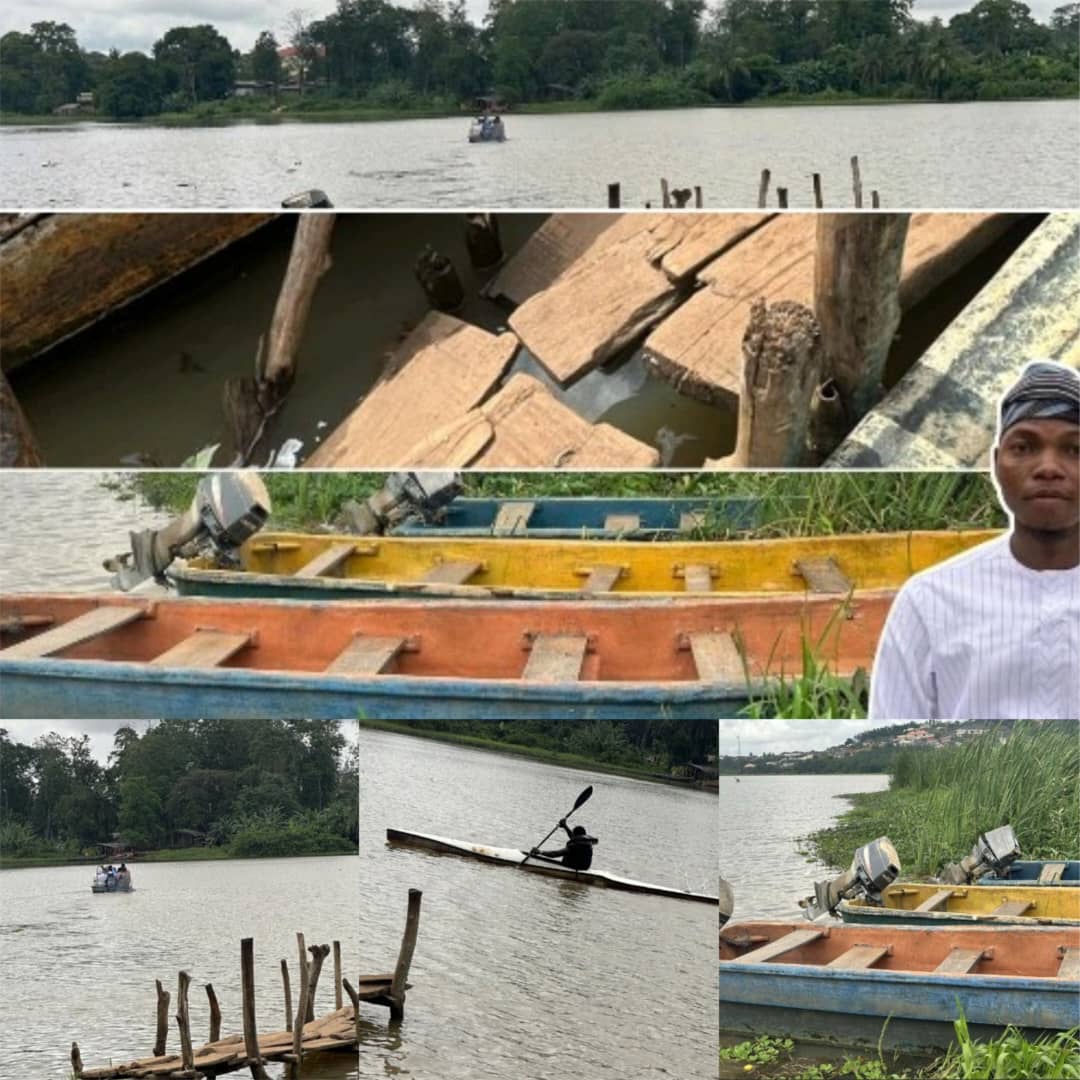
The boats are motorised, with plastic bodies, foam padding and flat wooden seats. A commonly observed arrangement consists of five wooden planks, with approximately three passengers seated on each plank, giving an estimated capacity of 15 passengers. However, the arrangement varies from one boat to another.
There are no conventional backrests. Passengers sit directly on the wooden planks, sometimes carrying children on their laps.
In some instances, operators ask adults travelling with more than one child to allow the children to sit together rather than carry several of them on their laps. Passengers are also instructed to adjust their positions when necessary to distribute weight and maintain the boat’s balance.
The crossing can take less than a minute when the operator accelerates at a higher speed. At other times, the journey lasts between two and three minutes, depending on passenger numbers, water conditions, approaching boats and how the operator regulates the engine.
During quieter periods, operators sometimes wait until they have enough passengers to make a trip worthwhile. Those in a hurry can pay for additional seats.
The risks behind the convenience
While life jackets are available at the crossing and some operators insist that passengers wear them, their use is not consistent. Some regular passengers, including children, board without requesting or wearing one.
The seating arrangements also raise questions about passenger capacity. Although approximately 15 people can fit into the commonly observed arrangement, the officially approved passenger limit for each boat could not be established.
Fuel handling is another area requiring attention. I observed some operators using ordinary plastic beverage bottles as fuel containers, with hoses connected to the engines.
The practice raises concerns about the safety of fuel storage and handling, particularly when passengers are on board.
The wooden planks and structures used for boarding also require regular maintenance. Some are exposed to constant moisture and other environmental conditions, with visible signs of deterioration. Water vegetation can further obstruct portions of the route.
These observations do not suggest that every operator disregards safety regulations. Practices differ among operators. While some make life jackets compulsory, others appear less strict.
The broader concern, however, is that passengers should not have to depend entirely on the individual attitude of whoever is operating their boat.
The crossing requires consistent safety standards that apply to every operator and passenger.
A lifeline that needs protection
I have used the crossing for approximately three years and now depend on it for about 60 per cent of my journeys to Eleyele and other destinations, including Dugbe, Oke Ado, Challenge, Ring Road, Mokola and Ologuneru.
Although I first learnt about the route many years ago, fear initially prevented me from using it. However, repeated journeys gradually made me more comfortable with travelling by water.
I have also introduced friends to the crossing, although many have declined because of their fear of water. Despite the familiarity that comes with regular use, the possibility of something going wrong remains.
This report is based on interviews with commuters and residents, direct observations at the crossing and my experience as a regular passenger. Several boat operators declined or were unavailable for interviews. One operator initially agreed to speak but later stopped responding.
For residents of Idunnu, Alakuta, Aderogba, Ogo Oluwa, Idi Mango and other neighbouring communities, the Eleyele River crossing provides an important transportation service.
Its affordability helps commuters save money, reduce travel time and access destinations that might otherwise be considerably more expensive to reach.
However, the people who depend on the service deserve more than an inexpensive ride.
Relevant government agencies and waterway authorities should collaborate with boat operators and community representatives to establish clear passenger limits, enforce consistent life-jacket use, conduct routine boat inspections, promote safe fuel storage and put basic emergency-response arrangements in place.
More importantly, there is a need to provide safer and more sophisticated boats.
Operators should also have access to safety training, properly maintained engines and vessels, while the wooden boarding structures should be assessed and upgraded to provide safer access for commuters.
Beyond the river crossing, the road infrastructure serving these communities also requires attention.
In March 2024, Hon. Remi Oseni, who represents Ido/Ibarapa East Federal Constituency, announced the reconstruction of the Awotan-Orioda-Alakuta Road, a project he facilitated.
However, the road, which has a drainage structure on one side, does not extend fully to Alakuta, leaving residents of Idunnu and other adjoining communities with persistent access challenges.
Government intervention is therefore necessary to extend and properly reconstruct the road towards these communities, making it easier for residents to access the river crossing and other destinations.
There is also an opportunity for responsible private-sector investment in safer boats, improved landing facilities and maintenance services.
Such investments should improve the quality and safety of the crossing without making fares unaffordable for the residents who depend on it.
The Idunnu Community Landlords’ Association and other community stakeholders can equally work with relevant authorities and operators to promote safer practices and encourage compliance with established standards.
The Eleyele River has become a blessing to many households, particularly those who cannot afford the longer road journey every day.
Its importance is evident in the hundreds of people who queue for boats every morning and return to the river in the evening.
But a blessing should not depend on luck.
For the commuters who depend on the crossing, the objective should not simply be to get across the water for ₦100. It should be to get there and return safely.
ABOUT THE AUTHOR
Kehinde Ayanboade is a journalist, researcher and academic based in Ibadan, Oyo State, Nigeria.