


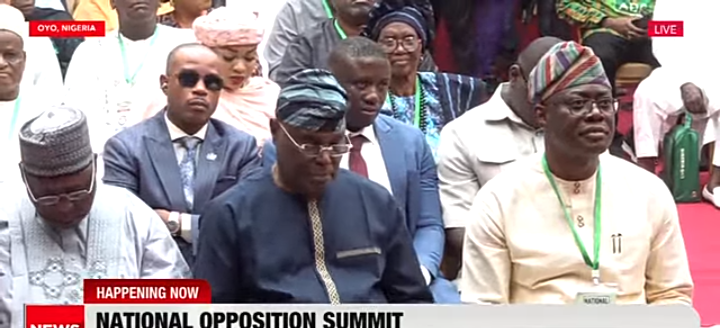
Governor Makinde Warns Against One Party State, Revives Memory of ‘Operation Wetie’ at Opposition Leaders Summit in Ibadan
Governor Seyi Makinde on Saturday raised fresh alarm over what he described as a dangerous drift toward a one party state in Nigeria, warning that democracy would lose its true meaning if credible opposition voices are weakened or silenced.
He spoke at the National Summit of Opposition Political Party Leaders held in Ibadan, which brought together former Vice President Atiku Abubakar, Labour Party presidential candidate Peter Obi, New Nigeria Peoples Party leader Rabiu Kwankwaso, former Minister Rotimi Amaechi, former Osun State Governor Rauf Aregbesola, alongside other opposition political leaders and stakeholders.
Makinde declared that democracy is not measured by the dominance of one political party but by the existence of real alternatives through which citizens can make meaningful choices.
According to him, once opposition parties become ineffective, what remains may still be called democracy in name, but it would no longer function in substance.
Makinde stressed that the presence of a strong and credible opposition should never be seen as a threat to any government, but rather as the lifeblood that keeps democratic governance open, competitive and accountable.
He warned that allowing opposition parties to decline, whether through deliberate actions or political neglect, would come with grave consequences for the country.
“Democracy without opposition is not democracy,” the governor said. “It is a slow drift toward a one party state, and Nigeria must not make that drift.”
The governor’s remarks come amid growing national debates over defections, shrinking opposition ranks and concerns that the political space is becoming increasingly tilted in favour of one dominant party.
Makinde also invoked turbulent political history in Nigeria, reminding participants on the infamous “Operation Wetie” crisis of the old Western Region, a period of violent political unrest that earned the era the nickname “Wild Wild West.”
By recalling the events, he cautioned political actors against repeating the mistakes of the past, where intolerance, political desperation and the destruction of opposition voices plunged part of the country into instability.
He noted pointedly that “Operation Wetie started from here,” underscoring Ibadan’s historical role as both a centre of political progress and political upheaval.
Makinde described Ibadan as the political capital of the South West and indeed Nigeria, noting that the city has long been central to national political conversations.
He recalled that as far back as the 1950s, Ibadan hosted critical constitutional discussions that helped shape Nigeria’s future, adding that those engagements were necessary because the structure of a nation must be deliberately built and when required rebuilt.
According to him, the present gathering carries a similar responsibility.
The governor dismissed any suggestion that the summit was targeted at President Bola Tinubu or driven by personal political ambition.
He said the meeting was not a gang up against any individual, but a gathering centred on the collective ambition of Nigerians to preserve a democracy that works for all.
“This is not about one man or personal ambition,” he said. “It is about the survival of a system that allows Nigeria to remain open, competitive and accountable.”
Makinde urged political leaders and citizens alike not to treat the current moment lightly, insisting that this is not the time for fragmentation, silence or political withdrawal.
Rather, he said, it is a time for clear thinking, honest conversations and responsible action that rises above party interests.
He added that Nigeria has come too far democratically to ignore the warning signs, stressing that safeguarding the nation’s democratic future is a responsibility that belongs to everyone.