


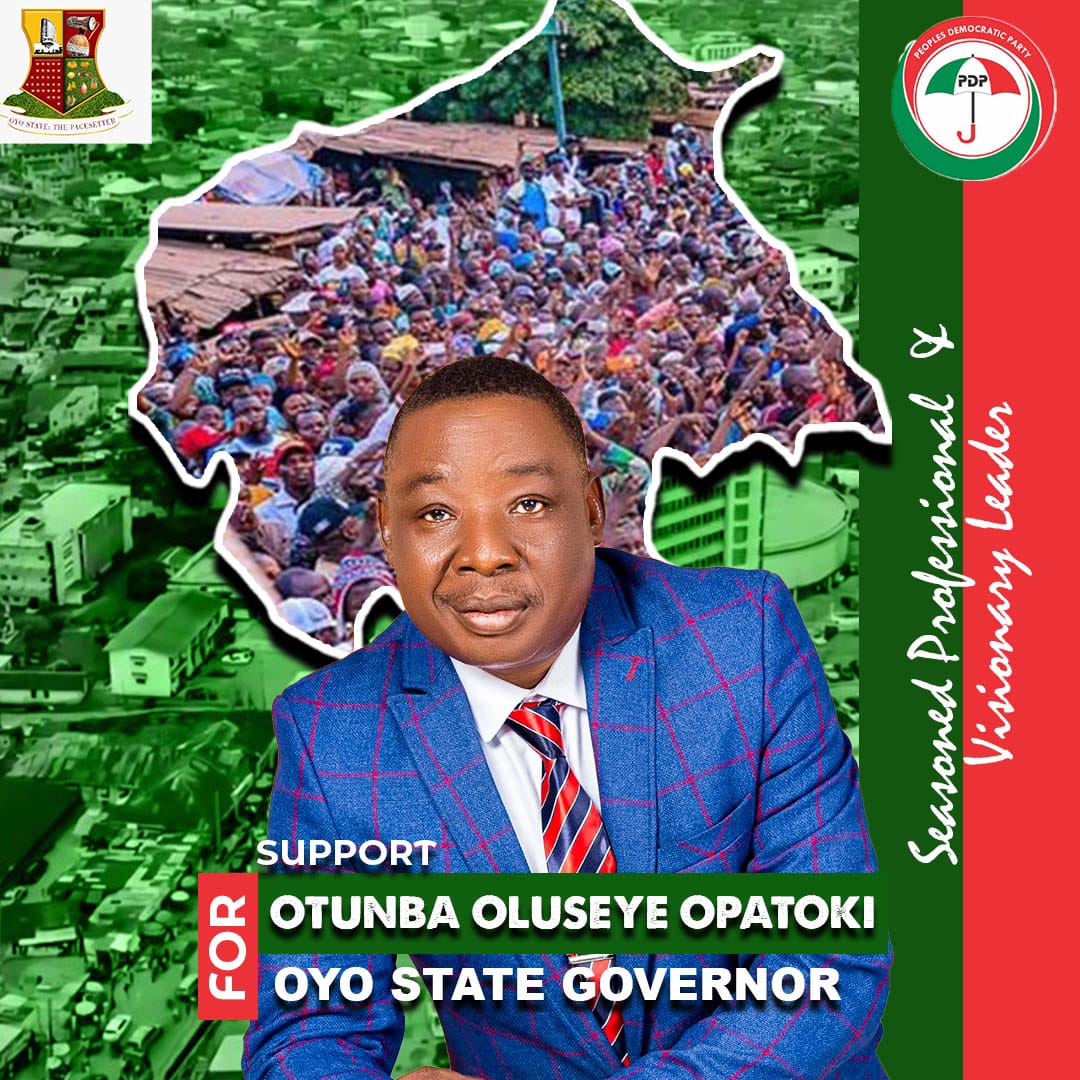
Oyo 2027: Ideas or Inducement? PDP Faces Defining Choice as Opatoki Pushes Policy First Politics
“When a party’s manifesto is written by the highest bidder, the government’s policy is written by the highest debtor.” — Governance warning
As the succession conversation around Seyi Makinde gathers momentum, the Peoples Democratic Party (PDP) in Oyo State is confronting a defining question: will it be driven by ideas or by inducement?
One aspirant, Oluseye Opatoki, has forced that debate into the open with an unconventional move—publishing his proposed contributions to the party’s manifesto before the party itself has formally drafted one.
Titled “PDP 2027: A Contract With Oyo,” the 41 page document is notably sparse on personal branding. It contains no photograph of Opatoki, but instead outlines 22 policy commitments, each backed by projected costs, timelines, and required legal frameworks. Circulating among ward leaders, it comes with a simple directive: “Adopt or amend, but do not ignore.”
The move flips the traditional script. Rather than waiting for the party to produce a manifesto and pledging to implement it, Opatoki is effectively shaping the agenda upfront and asking the party to align with it. Critics may see this as presumptuous; supporters call it strategic. Either way, it sets the tone for a contest increasingly defined by substance rather than patronage.
At the heart of the document is a clear contrast with what many describe as “money manifesto” politics, where aspirants secure delegate support through financial inducements and negotiate governance priorities after electoral victory. Opatoki’s approach instead proposes a pre agreed governance framework, where the party defines its commitments before choosing its flagbearer.
Among the key proposals are: granting financial autonomy to local governments within 90 days, establishing at least one primary healthcare centre per ward by the third year, advancing state policing with draft legislation ready, eliminating lobbying in civil service promotions, and creating a transparent procurement portal with a 48 hour appeals window.
By publishing early, Opatoki has strategically shaped the terrain of the race. Opponents now face a dilemma: adopt his proposals and concede agenda setting ground, reject them and justify why, or risk appearing derivative if they mirror them without acknowledgment.
Within party ranks, reactions are mixed. Some leaders argue the move undermines party hierarchy by pre empting the National Working Committee. Others see it as a necessary ideological reset for a party often criticised for lacking clear direction since 2015. In their view, a manifesto driven from the grassroots carries more legitimacy than one issued centrally.
The document also confronts longstanding concerns about internal party practices. It proposes the criminalisation of delegate inducement, with enforcement mechanisms involving party tribunals and collaboration with the Economic and Financial Crimes Commission (EFCC). It further recommends mandatory asset declarations for all aspirants prior to screening, an attempt to institutionalise transparency within the party.
This internal reform pitch doubles as a broader electoral strategy, particularly against the All Progressives Congress (APC), which faces its own criticisms over centralised candidate selection. Opatoki’s argument is clear: PDP can differentiate itself by becoming the party that elects, not selects.
Notably, the manifesto avoids national policy debates and focuses strictly on areas within a governor’s control, land administration, taxation, local security, education, and local governance. That focus lends credibility, particularly in a state where voters have historically rewarded practical governance over rhetorical deflection.
The initiative has also gained traction among younger demographics. A QR code embedded in the document links to a WhatsApp channel where citizens can propose amendments. More than 1,100 submissions have reportedly been received, marking a rare experiment in participatory manifesto development in Oyo politics.
Women’s groups have also highlighted the document’s emphasis on gender focused policies, with seven of the 22 commitments addressing issues such as maternal healthcare, market infrastructure, widow land rights, and cooperative law reform. The language deliberately shifts from “empowerment” to “entitlement,” signalling a rights based approach.
With the political timeline tightening ahead of 2026, the implications are significant. If Governor Makinde endorses a candidate aligned with this framework after it gains broad acceptance, that candidate inherits a ready made policy platform. If not, the alternative candidate must contend with a clearly articulated benchmark already in circulation.
There is, however, risk for Opatoki. By putting forward measurable commitments, he has effectively created a public scorecard that can be used against him if he secures the nomination and wins office. In contrast to inducement driven politics, where expectations often remain vague, this approach embraces scrutiny.
The document closes with a symbolic gesture: a signature line not for the aspirant, but for “The People of Oyo State,” accompanied by the words, “If I breach this, recall me.”
Whether or not Seyi Makinde ultimately backs him, that statement alone has already shifted the conversation, from who pays to who performs. And in politics, those who redefine the question often shape the outcome.